Our panoramic view of Cape Town, with the Company Garden in the foreground and the Table Mountain range being swallowed by a bank of clouds on the horizon.
TODAY IS THE 21st OF MARCH. The Vernal Equinox.
For the 87 percent of the world’s population inhabiting the Northern Hemisphere, this is the start of Spring.
But we are in South Africa, along with 800 million or so other humans living below the equator. And while the days and nights may be equal in length in both hemispheres (equinox is a portmanteau derived from two Latin words for “equal night”), it is the first day of Autumn in these parts. I’m still trying to get my head around this.
The climate over the past few weeks has been stultifying, no different than a late summer heat wave in the Northern Hemisphere. And today, as though on meteorologic cue, you can feel the crisp morning breeze signaling the change of seasons.
IT IS SATURDAY HERE IN Cape Town. Regardless of season, this means in a few hours we will hear the drummers drumming and the singers singing in the Company Garden park across the street. These are congregations of kids, organized by age, intoning African folk songs.
They are good. The harmonies are tight. Their voices are clear and strong and carry for quite a distance, echoing through the surrounding concrete buildings.
Hadeda Ibis, the noisiest bird in Africa.
Others voices — much less pleasant — also reverberate through the park and environs. One is the Egyptian Goose, which apparently is closer in species to a duck. They quack more than honk. They are highly territorial and begin complaining the minute any other creature — human, avian, mammalian — infringes upon their perceived space.
Their noisy objections are rhythmic, like a metronome, and quite persistent, with a beep-beep-beep that can last for several minutes before they finally, thankfully, give it a rest.
But they have nothing on the Hadeda Ibis, a large, somewhat plump bird with a long tapered beak, which squawks in a tone and volume reminiscent of those “ayuga” car horns, which, by comparison, seem mild and pleasant to this raucous creature.
These guys are considered the noisiest bird on the continent. No argument from me on that description.
A pair of these birds has been foraging on the lawns near the pool at our complex, pulling up the occasional grub or worm. They are not only loud, they are confident, showing no signs of shyness as they peck the soil and waddle within an arm’s length of humans.
Ayuga!
THE COMPANY GARDEN, by the way, is so named because it is where the Dutch East India Company cultivated this plot of land nearly four centuries ago to grow vegetables and fruits to refresh the ships en route between Amsterdam and Jakarta. In those early days, they had yet to appreciate the value of leafy greens and citrus fruit providing the necessary Vitamin C to prevent scurvy. Healthful benefits aside, the sailors, no doubt, welcomed any change in cuisine from a steady diet of hard tack and salted fish.
This cultivation endeavor, in what was then known as Kaapstadt, commenced in 1652. Not quite as old as the mythical Garden of Eden, but, on the other hand, still in existence to this day, albeit in a ceremonial rather than utilitarian capacity. Also, at least to my knowledge, no one here has been evicted for tasting any fruit arbitrarily deemed forbidden.
The view from our eighth story apartment is panoramic and mercurial. Although it is clear at the moment, it is bound to change. It reminds me of the old saying in Maine: If you don’t like the weather, just wait 20 minutes.
The pale blue sky is at the moment unobstructed and inert, but low hanging, lenticular clouds will at some point in the day begin to seep through the crevices of the sandstone ridge on the horizon, draping over the iconic Table Mountain like a table cloth. It’s a mesmerizing show, not unlike the fog rolling through and hugging the Golden Gate Bridge in San Francisco.
The slow-motion change in the landscape is like one of those high definition nature videos looping on a flat screen in the waiting room of most dentists’ offices these days. Only here, the view is the real thing, and there is no shrill whirring of a high-speed drill bit chewing away at some suffering patient’s corroded enamel to audibly and annoyingly interrupt the reverie of the scene.
Here, the view is a paradoxically bucolic urban setting, with just a few noisy birds as the soundtrack.
DOROTHY GALE, she of Oz fame, was fond of pronouncing: “There’s no place like home.” But, did she really mean it?
Was life on that monochromatic farm out in the middle of nowhere, Kansas, really better than the glorious Technicolor™ world of Oz, where she had met all kinds of characters and had experienced the time of her life?
I’m pretty sure she felt at least a tinge of ambivalence about the whole affair. She was reticent to leave Oz, but happy to be returning to her family.
Sherry and I can relate to Dorothy’s conundrum, if somewhat in reverse. We are sad in leaving home sweet home, yet exhilarated to be exploring a new chapter in our time together.
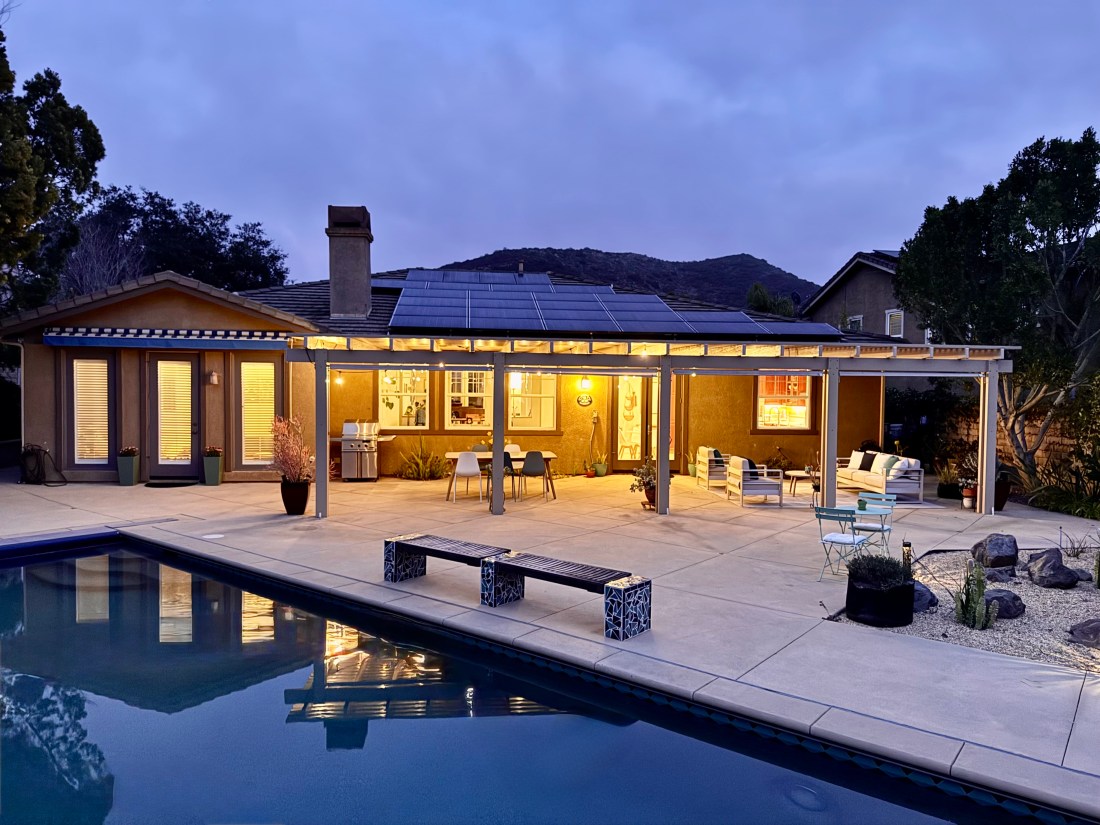
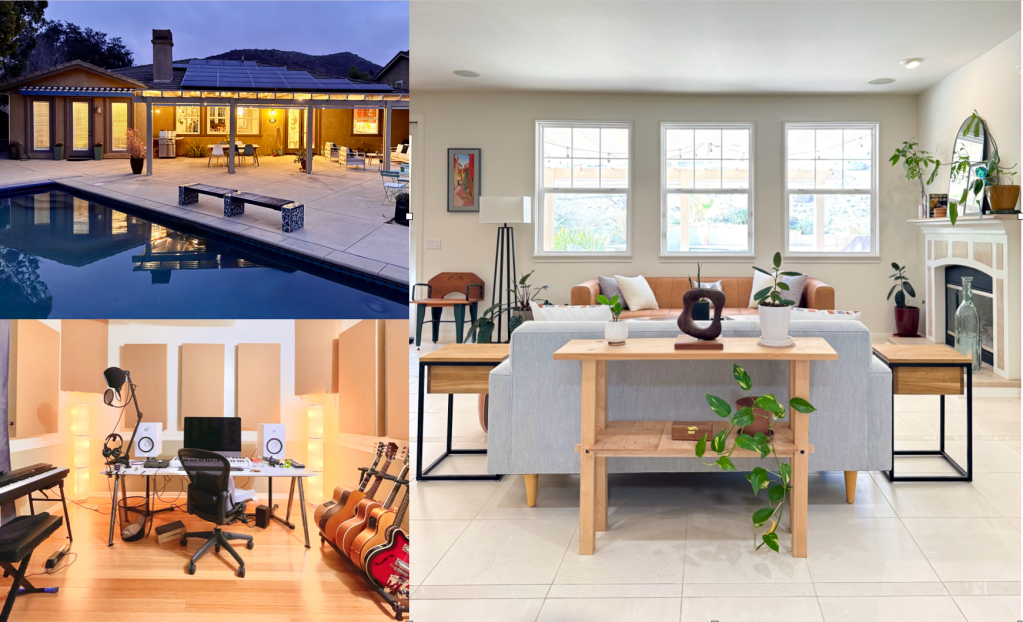
Top right: Our patio and much-used pool. Bottom left: Our music studio. Right: Our family room, including one-of-a-kind items we would not sell: The Japanese-style table Sherry and I made, a wood sculpture made by Francine Berg, a painting by Andy Newman, and underneath it a little school-house style bench I made. Plants are all Sherry’s handiwork.
WE LOVED OUR HUMBLE ABODE, nestled in the meandering hills of the Conejo Valley, California, just an hour north of L.A. and 20 minutes from the Pacific Ocean. We had wildlife visiting diurnally and nocturnally, often very vocally (owls hooting at 3 a.m. comes to mind).
It was a bucolic lifestyle. At dawn, we would sip our coffee to the pace of drifting fog, which by late morning would burn off to reveal yet another glorious day in the Golden State. At dusk, we could sip our wine, reveling in our panorama of the fuchsia-hued Santa Monica Mountains, as the sandstone peaks caught vestiges of light from the setting sun.
A view from our (former) backyard of the sun setting on the Santa Monica Mountains.
But we knew, unequivocally, it was time to leave it all behind on the morning of Nov. 6, 2025, as I described in this previous post. And so here we are, on the road, with no place to officially designate as “home” and no particular place to go. At the moment we are in an apartment in the U.K. Next week we’ll be in France. We have a vague plan that eventually takes us to South Africa, but that plan is certainly subject to change.
In February, when we put our home on the market and began packing up our things, we found ourselves wishing aloud that there were someway to magically transport our house to another land, preferably in some manner less turbulent than a tornado.
There is some place like home
THE DWELLING AND LAND that we occupied for nearly five years is a beautiful place.
We moved there at the height of the pandemic. During that stressful time, our new habitat felt like an oasis in the middle of a blinding sand storm.
Although it was a track home in a suburb, it was surrounded by open space. It had a very aesthetically pleasing yet practical design, and with lots of character, thanks to artistic flourishes commissioned by the previous owners.
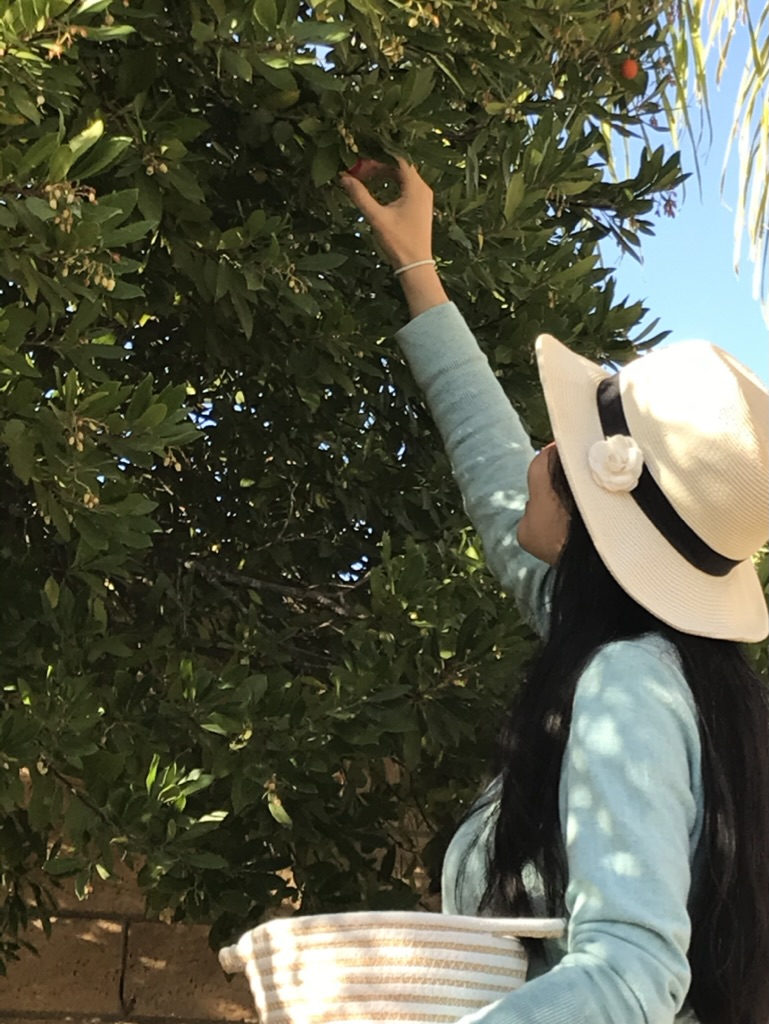
Sherry harvesting fruit from our strawberry tree.
It was our first real estate purchase together and we spent a copious amount of time adorning it with our own personal touches. We converted one room into a professional music studio (aka Sherry’s Batgirl Cave,1 since she spent an inordinate amount of time in there, often into the wee hours, mixing and producing).
We had a bright, spacious kitchen designed for cooking, where we doubled down on our culinary efforts and whipped up some savory repasts. As I write this, I can sense the scintillating aromas wafting about: sourdough bread fresh from the oven, or maybe briani (a Mauritian version of Indian biriani) simmering in a cast iron pot on the cooktop.2
Our backyard led to a protected, natural landscape (hence, the abundant wildlife). We had a lap pool and fruit trees. And when Sherry wasn’t in her Batgirl Cave, she was out tending to or harvesting her beds of herbs. She also became a proficient indoor gardener. Greenery of every variety adorned our walls, tables, shelves, and nooks and crannies.
Many days we found ourselves reciting this sentence: “Let’s never move again.” We were staying put. Done. Finished. Or so we thought. In the words of Yogi Berra: “It ain’t over until it’s over.”3
A trial run: Silicon Valley to Conejo Valley
THIS WAS NOT OUR FIRST GO on this merry-go-round. After Sherry moved in with me in my little rancher in the San Francisco Bay Area, we decided to do a complete remodel, transforming the ramshackle structure into a sleek, open, modern domicile. And then in 2018, we set about selling that home and most of our belongings to try the vagabond lifestyle before settling down again 24 months later. So, in some ways, that entire episode was a trial run; we just didn’t know it at the time.
Our previous home in Los Altos, CA. We converted a sleepy little rancher into an open, naturally lighted abode. We adorned our backyard with lots of homemade garden art. A mere two years later, we sold the house and most of our contents to hit the road.
Home is a state of mind
TO KEEP THINGS IN PERSPECTIVE, we think about the generations before us. My father’s parents were born and raised in a tiny village in Italy. They joined millions of their fellow citizens, emigrating in the 1890s to what they hoped would be a new and better life in the United States. I have documented that odyssey here. (My mother’s parents did the same in the early part of the 20th Century. I am researching that story now.)
Sherry’s family escaped war in China in the 1930s, in some cases by disguising themselves to stow aboard boats of questionable sea worthiness. After enduring a grueling maritime trip, they set foot on the tiny island of Mauritius in the middle of the Indian Ocean. They, too, could only hope that this new, tiny speck of terra firma would be the scene for a better life, clear of the violence and famine they had endured in their homeland.
Born to run, or at least to move
EACH GENERATION OF OUR species tends to view whatever events shaped their era as unique. But let’s face it, what we are going through is nothing compared to the first of our ancestors, who decided to leap down from a tree at the risk of being eaten by saber-tooth tigers.
Even our grandparents had it pretty easy in comparison to what those guys went through.
Once these ancient relatives descended from their arboreal perches, they began to look around and see what they could find. They were on the move. Then, some 400,000 years ago, as they continued to migrate, they began erecting shelters,4 thereby establishing a sense of permanency. And yet, they kept moving.
The cycle today might be that we establish “roots” somewhere, but then move — because of an employment opportunity, to help a family member, or just to seek out new horizons. Yet, the tendency to explore beyond our immediate environs seems permanently ingrained within some neurons deep inside our cerebral cortex that we inherited from long ago.
THE WESTERN CONCEPT of home is quite limited, when compared to other cultures. For the Bedouin people, it is not a place so much as a family. The denizens of Nuakata Island, Papua New Guinea refer to home as the village of their matrilineal ancestors. It has nothing to do with what dwelling they are currently inhabiting. The Warlpiri in Australia consider home a combination of where they came from and where they have camped in their lifetime.
The indigenous people of what is now the United States had many different approaches. The stereotype is usually nomadic tribes erecting tepees as they followed roaming bison herds. But tribes in the Northeast, such as the Mohegan, engineered and constructed wigwams, domestic structures so well insulated and waterproof that the European colonizers considered them far superior to the mud-and-straw huts they had left in their villages on the other side of the Atlantic.
Yet, these tribes didn’t necessarily consider those wigwams “home.” The lands in which they hunted and farmed were home. In his book “1491,” Charles Mann explains that these people didn’t sit still in one place and they didn’t exactly wander. They actually tended huge swaths of terrain, creating an entire ecosystem, in which controlled burning was used to fashion a sort of giant natural park. In that park they could readily harvest all the flora and fauna they needed for sustenance and for shelter. That was home to them.
Two of a kind, of one mind
WHEN SHERRY AND I FIRST MET, we both had already done a considerable amount of traveling. She out of necessity, having grown up in such a remote location. (Fun fact: Mauritius is just about half way around the world from California).
It’s a long way from California to Mauritius: 18,400 kilometers, or 11,500 miles.
For me, well, I guess I have the wandering gene in my DNA. At 18 months old, I embarked on my first solo bipedal journey. Apparently, I made it three blocks or so down a very busy West Street in Bristol, CT, before my mother caught up to me and summarily ended my odyssey. Of course, I was too young to remember that story, but it became family lore.
I inherited this wanderlust from my mother, undoubtedly. She had an indefatigable zest to search. There’s always a chance that something interesting just might be around the corner, so why not find out? 5
Then, in high school, my parents did just that, uprooting their entire clan of nine kids from the tiny hamlet of Whigville, CT., to pursue a new life. In the Nutmeg State, we were living in a century-old farmhouse, with the Nassahegan State Forest abutting our property and a dairy farm across the street. But somehow that wasn’t pastoral enough. So we ended up in the Pine Tree State — Maine — on our very own farm overlooking the Kennebec River, 90 miles south of the Quebec Province border. Now that was rural. We were out there.
The 100-acre farm my parents purchased, overlooking the Kennebec River in Solon, Maine, 90 miles south of the Canadian border. I spent my teen years learning to operate a tractor, a chainsaw and an axe, among other tools of the trade.
When I came of age, I set out to slake my thirst for the unknown, this time via automobile. A buddy and I took a cross-country road trip, which ended in California, where I immediately declared that this was where I wanted to live. Although most of my adult life has been in that state, I did take a break by living in Germany for a spell. And I have traveled to six continents and too many countries to count, whether on vacation or for work.
So, perhaps, it was meant to be, for two likeminded globetrotters to meet and share this passion for exploring the planet.
In the end, I guess, we can agree with Dorothy’s declaration: There is no place like home. Sure enough. But we’d hasten to qualify that proclamation with another well-worn, albeit corny but appropriate aphorism: Home is where the heart is.
FOOTNOTES:
A sort of portmanteau. Sherry’s love for fruit, especially mangos, has led me to surmise she was a fruit bat in a previous life. You can read more about her studio here. ↩︎
Yogi Berra also claimed: “I’ve never said most of the things I’ve said.” So we’ll have to take his definition of finality with a proverbial grain of salt. ↩︎
It could be as long as 1.8 millions year ago, depending on how you qualify what a structure is. ↩︎
Mom was always in search of a bargain. Second-hand stores, thrift stores, discount stores that sold dented cans, rejects, or day-old bread were always on her radar. But she was also an avid collector. If you hopped in the car with her to run an errand, you might end up 40 miles away at an antique store. ↩︎





 IRON-AGE EPILOG
You must be logged in to post a comment.