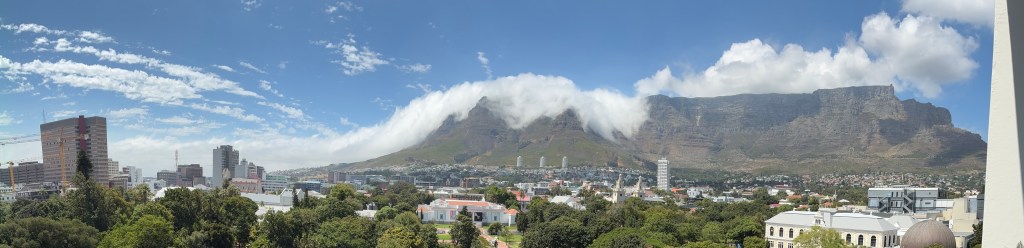
and the Table Mountain range being swallowed by a bank of clouds on the horizon.
TODAY IS THE 21st OF MARCH. The Vernal Equinox.
For the 87 percent of the world’s population inhabiting the Northern Hemisphere, this is the start of Spring.
But we are in South Africa, along with 800 million or so other humans living below the equator. And while the days and nights may be equal in length in both hemispheres (equinox is a portmanteau derived from two Latin words for “equal night”), it is the first day of Autumn in these parts. I’m still trying to get my head around this.
The climate over the past few weeks has been stultifying, no different than a late summer heat wave in the Northern Hemisphere. And today, as though on meteorologic cue, you can feel the crisp morning breeze signaling the change of seasons.
IT IS SATURDAY HERE IN Cape Town. Regardless of season, this means in a few hours we will hear the drummers drumming and the singers singing in the Company Garden park across the street. These are congregations of kids, organized by age, intoning African folk songs.
They are good. The harmonies are tight. Their voices are clear and strong and carry for quite a distance, echoing through the surrounding concrete buildings.

Others voices — much less pleasant — also reverberate through the park and environs. One is the Egyptian Goose, which apparently is closer in species to a duck. They quack more than honk. They are highly territorial and begin complaining the minute any other creature — human, avian, mammalian — infringes upon their perceived space.
Their noisy objections are rhythmic, like a metronome, and quite persistent, with a beep-beep-beep that can last for several minutes before they finally, thankfully, give it a rest.
But they have nothing on the Hadeda Ibis, a large, somewhat plump bird with a long tapered beak, which squawks in a tone and volume reminiscent of those “ayuga” car horns, which, by comparison, seem mild and pleasant to this raucous creature.
These guys are considered the noisiest bird on the continent. No argument from me on that description.
A pair of these birds has been foraging on the lawns near the pool at our complex, pulling up the occasional grub or worm. They are not only loud, they are confident, showing no signs of shyness as they peck the soil and waddle within an arm’s length of humans.
Ayuga!
THE COMPANY GARDEN, by the way, is so named because it is where the Dutch East India Company cultivated this plot of land nearly four centuries ago to grow vegetables and fruits to refresh the ships en route between Amsterdam and Jakarta. In those early days, they had yet to appreciate the value of leafy greens and citrus fruit providing the necessary Vitamin C to prevent scurvy. Healthful benefits aside, the sailors, no doubt, welcomed any change in cuisine from a steady diet of hard tack and salted fish.
This cultivation endeavor, in what was then known as Kaapstadt, commenced in 1652. Not quite as old as the mythical Garden of Eden, but, on the other hand, still in existence to this day, albeit in a ceremonial rather than utilitarian capacity. Also, at least to my knowledge, no one here has been evicted for tasting any fruit arbitrarily deemed forbidden.
The view from our eighth story apartment is panoramic and mercurial. Although it is clear at the moment, it is bound to change. It reminds me of the old saying in Maine: If you don’t like the weather, just wait 20 minutes.
The pale blue sky is at the moment unobstructed and inert, but low hanging, lenticular clouds will at some point in the day begin to seep through the crevices of the sandstone ridge on the horizon, draping over the iconic Table Mountain like a table cloth. It’s a mesmerizing show, not unlike the fog rolling through and hugging the Golden Gate Bridge in San Francisco.
The slow-motion change in the landscape is like one of those high definition nature videos looping on a flat screen in the waiting room of most dentists’ offices these days. Only here, the view is the real thing, and there is no shrill whirring of a high-speed drill bit chewing away at some suffering patient’s corroded enamel to audibly and annoyingly interrupt the reverie of the scene.
Here, the view is a paradoxically bucolic urban setting, with just a few noisy birds as the soundtrack.
 IRON-AGE EPILOG
You must be logged in to post a comment.