Featured

For whom does the bell really toll?

In France, the ringing is incessant

SHOULD YOU DESIRE to escape the din of daily life and decompress by soaking up the local culture of a quaint, quiet village or town in France, here’s a pro tip: Stay away from churches.

To be clear, I’m not advising you against visiting or patronizing a place of religious worship. But if you enjoy sleeping in on vacation, beware that these houses of the holy contain bell towers, or what can easily be described as the world’s largest alarm clocks.

Turn sound on: The bell tower of the church of
Ste. Thérèse ringing out in Rennes, France

As a seasoned traveler who is also a light sleeper, I have an exhaustive list of places to avoid when securing lodging: busy streets and intersections, hospitals, fire departments, sports stadiums, bars and clubs. But until now, “church bells” was not on the list.

In France, there are somewhere around 45,000 places of worship, most of them of the Catholic persuasion. The overwhelming majority of these temples possess a lofty tower where a hefty tube of cast bronze is suspended. And when that metal-alloy cylinder is struck with what is known as a clapper, the reverberation can be heard and the resonance felt for great distances.

Moreover, the knell of the bell is not a rare event. Every occasion seems to warrant a clanging. They chime to announce the hour. They toll vigorously to recruit parishioners for services, of which there are many throughout the week, especially on Sunday. They peal excitedly for what seems hours on end to honor a multitude of saints on the days of their birth or their martyrdom.1


On the town

WE ARE TEMPORARILY residing in the city of Rennes, France, situated at the confluence of the Ille and Vilaine rivers, which drain into the Bay of Biscay and the Atlantic Ocean some 100 Km to the southwest. The weather here is mild, often overcast and sometimes rainy, as is typical of a coastal town.

Front view of Church of
Ste. Thérèse

This city is the administrative capital or prefecture of Brittany. And although Rennes boasts a population of nearly 750,000 in the greater metropolis, it’s really more of an aggregation of tiny villages and neighborhoods, many with the requisite cobblestone streets, provincial-style residences and small shops (which seem to be closed most of the time). There are also many modern apartment buildings and offices. This city even has a subway system. But in general, the place feels unhurried, relaxed, low-key.
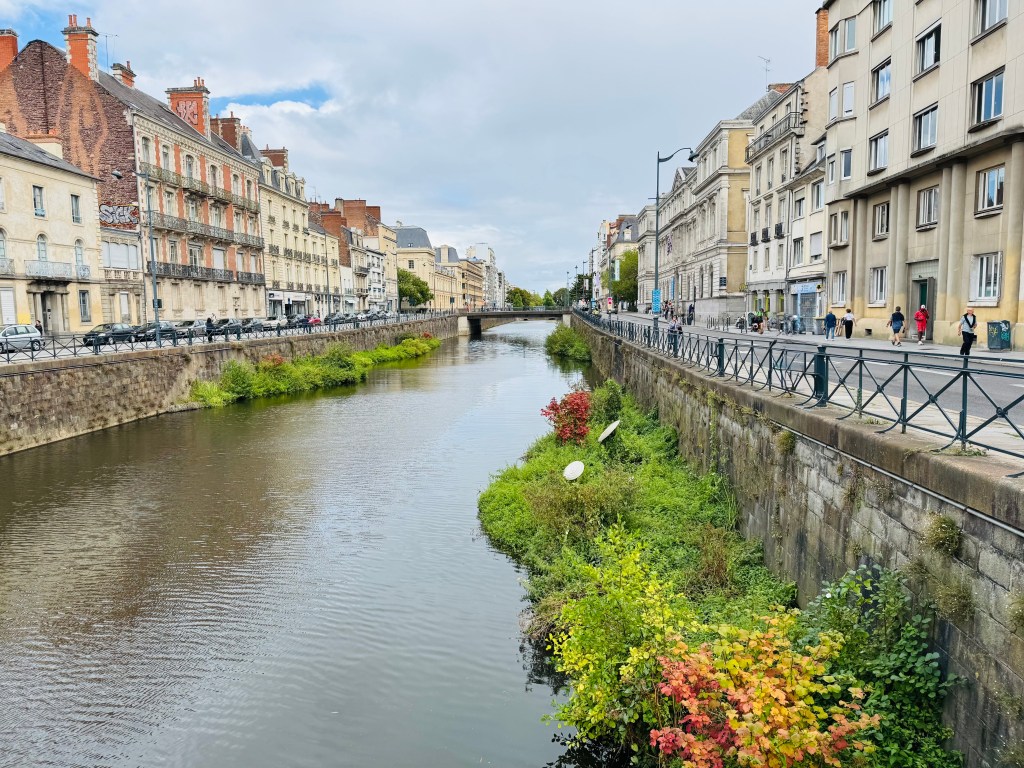
The city of Rennes, France, along the Vilaine River.

In our little quiet neighborhood, we may hear magpies, crows, seagulls, pigeons and an occasional backyard dog voicing objection to its aerial companions. Cars, trains and the usual hub-bub of city life are barely audible. We rarely detect jets overhead, even though there is a regional airport just six or so kilometers away.

And then this serenity is interrupted by the ding-donging.

We are across the street from the Eglise de Sainte Thérèse, an impressive neo-Gothic structure built about 100 years ago. They spared no expense on the bell towers. And whatever that cost was, they have gotten their money’s worth. From 8 a.m. until 8 p.m., they ring on the hour. (Occasionally, however, someone might lose count. )

A view from our apartment of Rennes, France. The flat terrain allows ringing bells to be heard at great distances.

For religious services, there is a preamble — a warning of sorts — of three sets of three rings. And then, after a brief interlude, all hell’s bells break loose. This carillon2 cacophony may endure for ten or fifteen minutes. For the musicians reading this, I detect four tones: 1. The tonic, 2. A major second, 3. A major third, 4. An octave. If you remember singing class in school, this would be DO-RE-MI-DO.

Every neighborhood has its own church with its own bell tower. Because the terrain is flat, the sound carries unimpeded. Frequently, not just one, but as many as three or four churches nearby compete for attention with Sainte Thérèse.

All this chiming got me to thinking how this tradition got started and, perhaps more to the point, why this anachronism persists.


Hear ye, hear ye

LOUD SOUNDS HAVE BEEN used to communicate for just about as long as humans have been assembling in social groups. Whether its a conch shell or a drum, any reverberation that can carry for long distances has been used to convey a warning (enemy is approaching), or perhaps an invitation (festival tonight to celebrate the solstice).

Once organized religion became commonplace, trumpets, gongs and other such instruments were used to invite the masses to, well, Mass. It wasn’t until 604 A.D. that a Pope Sabinian sanctioned bells as the most effective method of communication.3 And the rest, as they say, is history.
The question, though, is why continue? In this day and age, we certainly don’t need any reminder of the time of day. And, let’s face it, the bell-ringers are not going to be as accurate as a smartphone clock, which is synchronized over the air with an atomic timekeeper (located in some secret bunker in the Colorado mountains) right down to the millisecond.

As for the announcements of religious services, wouldn’t a group text be more effective? (Add a link to a Patreon page to skip the fund-raising basket that’s passed from pew to pew during services.)

In fact, all this ringing can unequivocally be defined as noise pollution. Studies in Switzerland and the Netherlands have concluded just this. But tradition is strong here in the land of the Gauls, and it is unlikely the musical tones emanating loudly and clearly through villages, towns and cities will be silenced by some silly, modern notion of what constitutes clangour.4

So I, consequently, have developed my own tradition to cope when the boisterous bells erupt, which is to mutter under my breath: “Off with their heads!”


FOOTNOTES

  1. France boasts 1,376 Catholic saints, of which 656 died as martyrs. ↩︎
  2. Carillon is derived from Old French quarregnon, which means the peal of four bells. ↩︎
  3. Pope Sabinian was only in charge for two years, but he certainly achieved a rather notorious kind of immortality with his bell-ringing decision. ↩︎
  4. Clangour is defined as a loud non-musical noise made by a banging or ringing sound. ↩︎

Sherry & George’s great adventure

Featured

Going, going, gone: How and why we left the U.S.

AS I WRITE THIS, I am sitting at a tiny kitchen table in a flat on the 20th floor of some nondescript apartment building in Canary Wharf, London.

Our cantilevered balcony, with its tempered glass wall, provides a bird’s-eye view of the Isle of Dogs Canal some 200 feet (or 60 meters) below, but obtaining that perspective means standing on said balcony, which provokes a serious case of vertigo. And so we content ourselves with a more limited but secure view from indoors.

Our panoramic view of the Isle of Dogs.

We arrived late last night, after a long day’s journey by train from Frankfurt, Germany that carried us past rolling hills, mustard fields and verdant forests and then, with the screech of the brakes, plunged us into the mayhem, chaos and attitude that is so très Paris.

There we switched from the TGV (Train à Grande Vitesse, or high speed train) to the Eurostar, to be whisked through the Chunnel to Merry Ol’ England.

One of the minor details I missed when booking the tickets was that we would be switching not only trains, but train stations. Traveling from Gare de l’Est to Gare du Nord requires a mere 5-minute cab ride. But convincing a taxi driver in France (where arrogance is apparently written into the job description) to help load a pallet-load of luggage (we are not traveling lightly) for such a short distance, then ferry us through lunch-time traffic but a mere number of blocks, and then help unload the bags was no easy task. Sherry’s fluency in French (and fluency in assertiveness, I might add) came in handy. So did the €20 I handed the cabbie.

Our motivation for this sojourn was not so much to come here as it was to get out of the United States.

The romance of traveling by train is gone

ONCE INSIDE THE STATION, we were met with a cacophony of fellow travelers, all of them in a hurry and more than a few of them rude, a labyrinth of checkpoints with impatient attendants shouting orders and cursing the ignorance of the passengers. Thanks to Brexit, we had to elbow our way through multiple security screenings and baggage X-ray machines that made the TSA seem positively tame.

The Eurostar train was comfortable and relatively quiet. The staff were polite and the meal was fair (certainly improved with a glass of white wine). This all provided a bit of respite for what was to follow.

We arrived at St. Pancras Station and took the quintessential Black Cab (or hackney carriage, if you prefer) during the height of commute hour to our apartment. If you don’t know the set-up of these rigs, your luggage is placed in front of you in the passenger area, not in some trunk. Each swerve of the cab illustrates in real time Newtonian physics, with an equal and opposite reaction. A body in motion — or luggage in this case — stays in motion, until met by a human body that bears the brunt of all the jostling.

That was the easy part. Getting the key to the rental unit was an ordeal unlike any we have encountered, and we are very seasoned travelers. This all added at least an hour (and an additional £25) to our already taxing journey, but we finally found entry to the building, ascended the “lift” to the aforementioned flat and collapsed.

On a stroll across a pedestrian bridge spanning the Isle of Dogs Canal on an unseasonably warm and sunny day for April in London.

We have a bit of business in London to attend to, and friends and family to visit. Beyond that, our plans are vague, undefined. That is because our motivation for this sojourn was not so much to come here as it was to get out of the United States.

In with the Ex-pats

MOST LIKELY YOU’VE read stories about citizens of the U.S. contemplating a permanent change of address, leaving the country because of the political calamity now engulfing the world’s largest economy (a position that might not hold for long, based on the current downward trajectory). Some estimates claim 20 percent of U.S. citizens are investigating emigration. But do you know anyone who has actually followed through with that intent? Well, you do now.

Here is how it unfolded:

On Nov. 6, 2024, I awoke to the news that still to this day seems incredulous. I found myself that morning pacing the kitchen floor and actually heard myself uttering this phrase aloud: “We have to get out of here.”

I’m an early riser, while my better half is a night owl. But within minutes of arising and hearing the news herself, she was in agreement with me and we began to discuss our options.

We are decisive. We are also organized. And so a strategy with spreadsheets and punch lists was created, and we went to work executing our grand plan.

Within a month of that fateful November day, we had interviewed several realtors and chosen one to represent us in putting our humble abode on the market.

In the meantime, we arranged for the sale of almost all our personal belongings, and the very tiny portion of goods that we kept were either sent to storage or put aside to be stuffed into our travel luggage.

In between all that frenetic activity, we actually spent a few weeks in Malaysia and Taiwan for a milestone-birthday family celebration on Sherry’s side of the family. This excursion was more like a business trip, since an inordinate amount of time was consumed working on our exit plan remotely, with voluminous conference calls, emails and texts.

We returned to the U.S., and by mid-April, we were done with all of it. The title to the house was in the buyers’ hands, their money was in our bank. And so we hopped in a rental car (we had already sold our vehicle) for one final road trip to visit family and then to tick off a few bucket-list tourist spots (namely, the Hoover Dam and Death Valley, both of which I highly recommend visiting).

We returned the rental in L.A., where we spent a few days downtown (our old haunt). Then, on Monday morning, 21 April, we boarded a very creaky Lufthansa 747 at LAX and landed some 12 hours later in Frankfurt. We chose Germany as a starting point to our new adventure because Sherry hadn’t been there before and I thought I could show her around the place, since I lived there for a spell.

We didn’t get to much of the tourism portion of the plan. That’s because we hadn’t planned on the Big Crash. To be clear, I don’t mean the stock market. We actually anticipated that one (as did most of the thinking world). This one was physical, emotional, and compounded by jet lag. We had been running on adrenaline for six months, a frenetic pace that included copious amounts of stress and more than one or two raised voices with our real estate agent, our estate sales manager and one or two other contractors handling things.

And when it was all done, we were exhausted. We also still had quite a bit of “paperwork” to finish, bank accounts, changes of address, and travel arrangements to make. So we wound up mostly holed up in a typically utilitarian German apartment for the better part of a week. We did visit our local neighborhood, which was a pleasant blend of shops and cuisine from around the world. And we did hop on a train for a day trip to Heidelberg, which I’ll post about later.

What comes next is anybody’s guess

NEITHER OF US WANTED to leave. We had a beautiful home nestled in a pleasant little burb with plenty of open space in Southern California. We had coyotes, bobcats, rattlesnakes, hawks, owls, rabbits, even roadrunners in our midst. We were 20 minutes by car from the azure waters of the Pacific Ocean. We’d take a weekend every so often to L.A., which usually included a night at the Philharmonic and a dinner at our favorite little Italian restaurant. We had a very comfortable life. But it was clear to us on that day in November that the U.S. had reached a point of no return to any sense of normalcy.1

For those of you who plan to stay and fight, we applaud you. But for us, we are taking our cue from that great poet-philosopher-songwriter and TV personality Kenny Rogers: “You’ve got to know when to hold ’em, know when to fold ’em, know when to walk away, know when to run.2

We don’t know exactly know where we will go or what will follow, we only know it was time to run.

Stay tuned.

——————————————————————-

1A term unwittingly coined by Herbert Hoover.

2For those readers old enough to remember that classic hit, “The Gambler,” I apologize for having condemned your brain to running that melody on infinite loop. It should subside in about 24 hours, if my experience is any indicator.