DOROTHY GALE, she of Oz fame, was fond of pronouncing: “There’s no place like home.” But, did she really mean it?
Was life on that monochromatic farm out in the middle of nowhere, Kansas, really better than the glorious Technicolor™ world of Oz, where she had met all kinds of characters and had experienced the time of her life?
I’m pretty sure she felt at least a tinge of ambivalence about the whole affair. She was reticent to leave Oz, but happy to be returning to her family.
Sherry and I can relate to Dorothy’s conundrum, if somewhat in reverse. We are sad in leaving home sweet home, yet exhilarated to be exploring a new chapter in our time together.
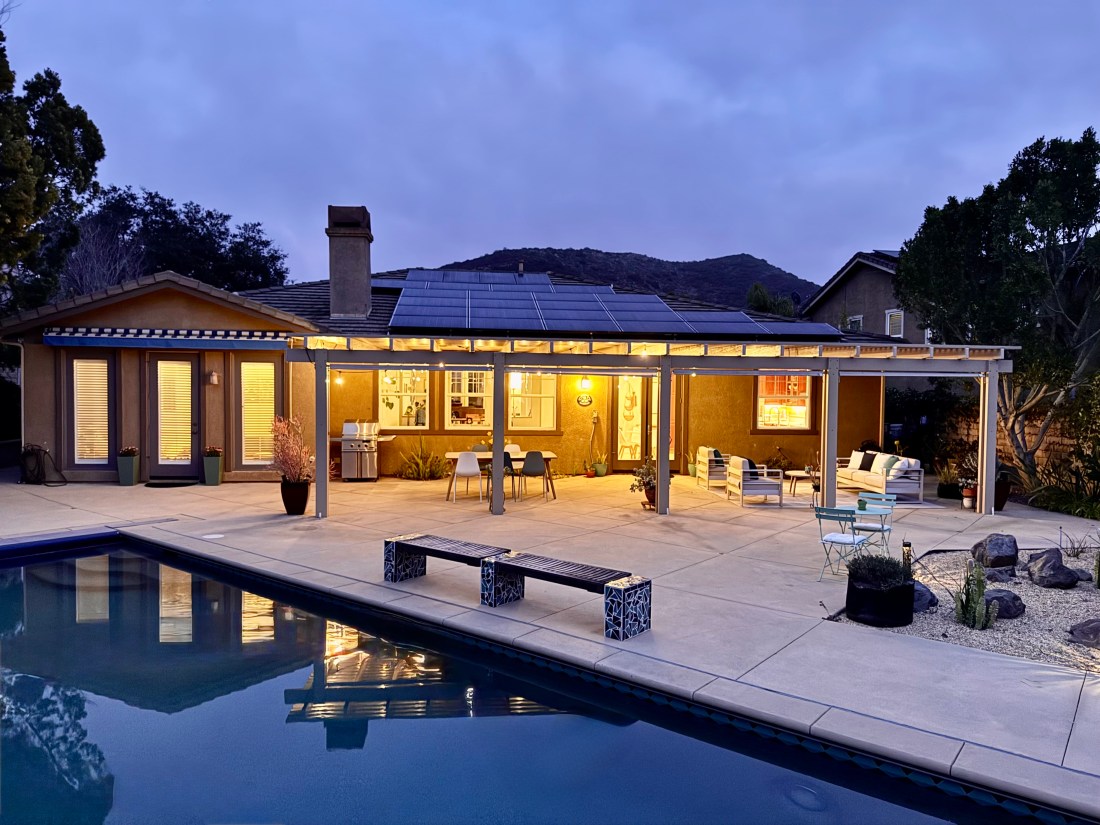
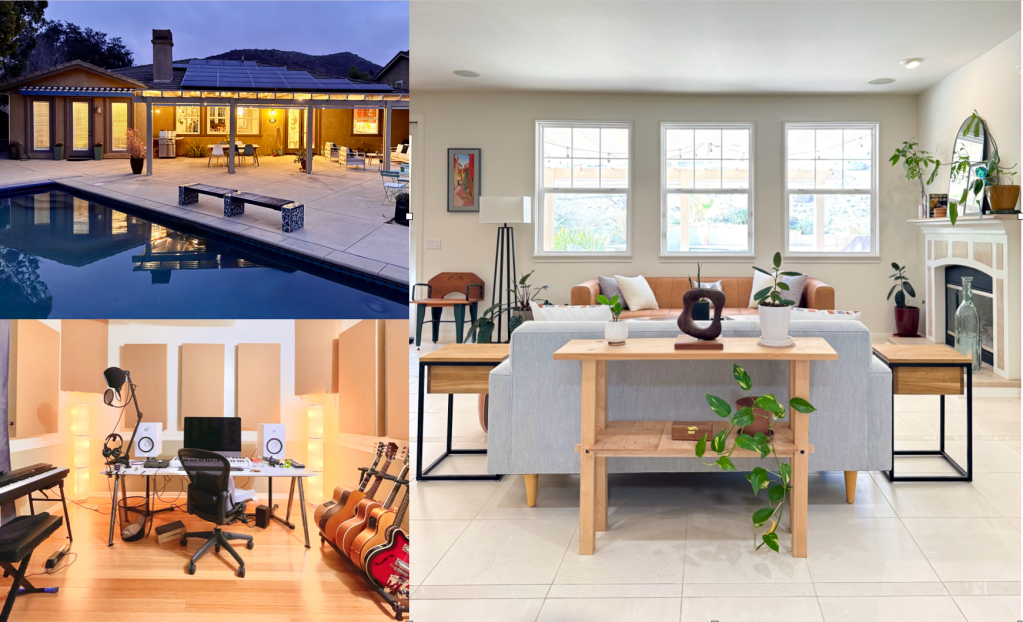
Top right: Our patio and much-used pool. Bottom left: Our music studio. Right: Our family room, including one-of-a-kind items we would not sell: The Japanese-style table Sherry and I made, a wood sculpture made by Francine Berg, a painting by Andy Newman, and underneath it a little school-house style bench I made. Plants are all Sherry’s handiwork.
WE LOVED OUR HUMBLE ABODE, nestled in the meandering hills of the Conejo Valley, California, just an hour north of L.A. and 20 minutes from the Pacific Ocean. We had wildlife visiting diurnally and nocturnally, often very vocally (owls hooting at 3 a.m. comes to mind).
It was a bucolic lifestyle. At dawn, we would sip our coffee to the pace of drifting fog, which by late morning would burn off to reveal yet another glorious day in the Golden State. At dusk, we could sip our wine, reveling in our panorama of the fuchsia-hued Santa Monica Mountains, as the sandstone peaks caught vestiges of light from the setting sun.
A view from our (former) backyard of the sun setting on the Santa Monica Mountains.
But we knew, unequivocally, it was time to leave it all behind on the morning of Nov. 6, 2025, as I described in this previous post. And so here we are, on the road, with no place to officially designate as “home” and no particular place to go. At the moment we are in an apartment in the U.K. Next week we’ll be in France. We have a vague plan that eventually takes us to South Africa, but that plan is certainly subject to change.
In February, when we put our home on the market and began packing up our things, we found ourselves wishing aloud that there were someway to magically transport our house to another land, preferably in some manner less turbulent than a tornado.
There is some place like home
THE DWELLING AND LAND that we occupied for nearly five years is a beautiful place.
We moved there at the height of the pandemic. During that stressful time, our new habitat felt like an oasis in the middle of a blinding sand storm.
Although it was a track home in a suburb, it was surrounded by open space. It had a very aesthetically pleasing yet practical design, and with lots of character, thanks to artistic flourishes commissioned by the previous owners.
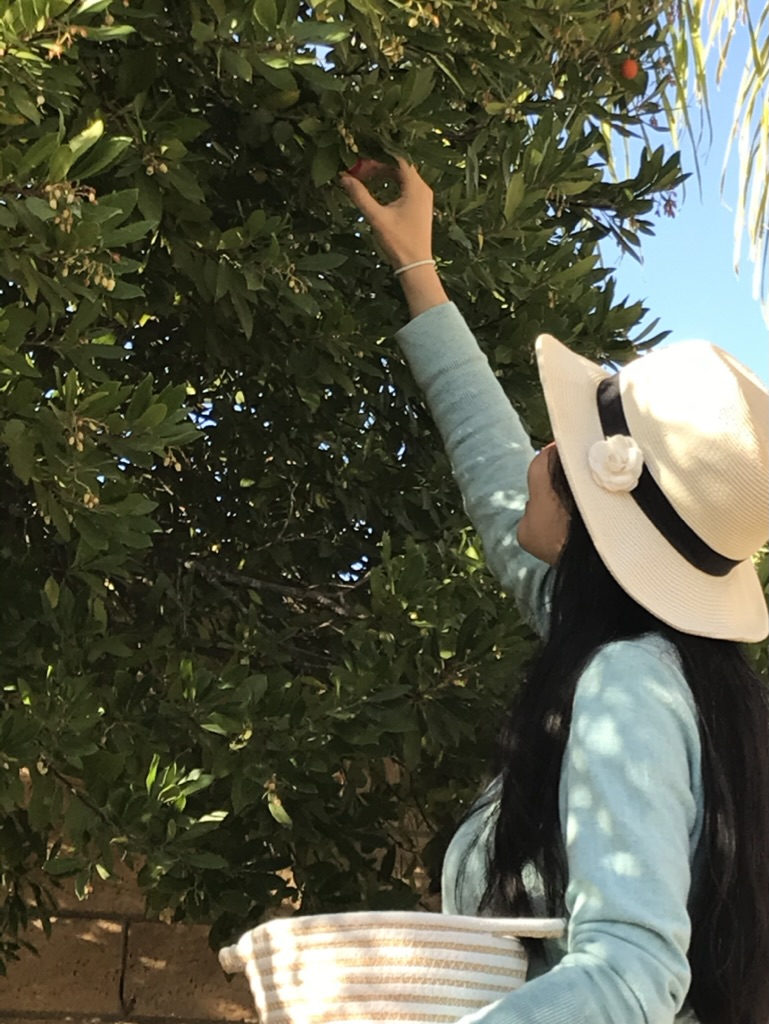
Sherry harvesting fruit from our strawberry tree.
It was our first real estate purchase together and we spent a copious amount of time adorning it with our own personal touches. We converted one room into a professional music studio (aka Sherry’s Batgirl Cave,1 since she spent an inordinate amount of time in there, often into the wee hours, mixing and producing).
We had a bright, spacious kitchen designed for cooking, where we doubled down on our culinary efforts and whipped up some savory repasts. As I write this, I can sense the scintillating aromas wafting about: sourdough bread fresh from the oven, or maybe briani (a Mauritian version of Indian biriani) simmering in a cast iron pot on the cooktop.2
Our backyard led to a protected, natural landscape (hence, the abundant wildlife). We had a lap pool and fruit trees. And when Sherry wasn’t in her Batgirl Cave, she was out tending to or harvesting her beds of herbs. She also became a proficient indoor gardener. Greenery of every variety adorned our walls, tables, shelves, and nooks and crannies.
Many days we found ourselves reciting this sentence: “Let’s never move again.” We were staying put. Done. Finished. Or so we thought. In the words of Yogi Berra: “It ain’t over until it’s over.”3
A trial run: Silicon Valley to Conejo Valley
THIS WAS NOT OUR FIRST GO on this merry-go-round. After Sherry moved in with me in my little rancher in the San Francisco Bay Area, we decided to do a complete remodel, transforming the ramshackle structure into a sleek, open, modern domicile. And then in 2018, we set about selling that home and most of our belongings to try the vagabond lifestyle before settling down again 24 months later. So, in some ways, that entire episode was a trial run; we just didn’t know it at the time.
Our previous home in Los Altos, CA. We converted a sleepy little rancher into an open, naturally lighted abode. We adorned our backyard with lots of homemade garden art. A mere two years later, we sold the house and most of our contents to hit the road.
Home is a state of mind
TO KEEP THINGS IN PERSPECTIVE, we think about the generations before us. My father’s parents were born and raised in a tiny village in Italy. They joined millions of their fellow citizens, emigrating in the 1890s to what they hoped would be a new and better life in the United States. I have documented that odyssey here. (My mother’s parents did the same in the early part of the 20th Century. I am researching that story now.)
Sherry’s family escaped war in China in the 1930s, in some cases by disguising themselves to stow aboard boats of questionable sea worthiness. After enduring a grueling maritime trip, they set foot on the tiny island of Mauritius in the middle of the Indian Ocean. They, too, could only hope that this new, tiny speck of terra firma would be the scene for a better life, clear of the violence and famine they had endured in their homeland.
Born to run, or at least to move
EACH GENERATION OF OUR species tends to view whatever events shaped their era as unique. But let’s face it, what we are going through is nothing compared to the first of our ancestors, who decided to leap down from a tree at the risk of being eaten by saber-tooth tigers.
Even our grandparents had it pretty easy in comparison to what those guys went through.
Once these ancient relatives descended from their arboreal perches, they began to look around and see what they could find. They were on the move. Then, some 400,000 years ago, as they continued to migrate, they began erecting shelters,4 thereby establishing a sense of permanency. And yet, they kept moving.
The cycle today might be that we establish “roots” somewhere, but then move — because of an employment opportunity, to help a family member, or just to seek out new horizons. Yet, the tendency to explore beyond our immediate environs seems permanently ingrained within some neurons deep inside our cerebral cortex that we inherited from long ago.
THE WESTERN CONCEPT of home is quite limited, when compared to other cultures. For the Bedouin people, it is not a place so much as a family. The denizens of Nuakata Island, Papua New Guinea refer to home as the village of their matrilineal ancestors. It has nothing to do with what dwelling they are currently inhabiting. The Warlpiri in Australia consider home a combination of where they came from and where they have camped in their lifetime.
The indigenous people of what is now the United States had many different approaches. The stereotype is usually nomadic tribes erecting tepees as they followed roaming bison herds. But tribes in the Northeast, such as the Mohegan, engineered and constructed wigwams, domestic structures so well insulated and waterproof that the European colonizers considered them far superior to the mud-and-straw huts they had left in their villages on the other side of the Atlantic.
Yet, these tribes didn’t necessarily consider those wigwams “home.” The lands in which they hunted and farmed were home. In his book “1491,” Charles Mann explains that these people didn’t sit still in one place and they didn’t exactly wander. They actually tended huge swaths of terrain, creating an entire ecosystem, in which controlled burning was used to fashion a sort of giant natural park. In that park they could readily harvest all the flora and fauna they needed for sustenance and for shelter. That was home to them.
Two of a kind, of one mind
WHEN SHERRY AND I FIRST MET, we both had already done a considerable amount of traveling. She out of necessity, having grown up in such a remote location. (Fun fact: Mauritius is just about half way around the world from California).
It’s a long way from California to Mauritius: 18,400 kilometers, or 11,500 miles.
For me, well, I guess I have the wandering gene in my DNA. At 18 months old, I embarked on my first solo bipedal journey. Apparently, I made it three blocks or so down a very busy West Street in Bristol, CT, before my mother caught up to me and summarily ended my odyssey. Of course, I was too young to remember that story, but it became family lore.
I inherited this wanderlust from my mother, undoubtedly. She had an indefatigable zest to search. There’s always a chance that something interesting just might be around the corner, so why not find out? 5
Then, in high school, my parents did just that, uprooting their entire clan of nine kids from the tiny hamlet of Whigville, CT., to pursue a new life. In the Nutmeg State, we were living in a century-old farmhouse, with the Nassahegan State Forest abutting our property and a dairy farm across the street. But somehow that wasn’t pastoral enough. So we ended up in the Pine Tree State — Maine — on our very own farm overlooking the Kennebec River, 90 miles south of the Quebec Province border. Now that was rural. We were out there.
The 100-acre farm my parents purchased, overlooking the Kennebec River in Solon, Maine, 90 miles south of the Canadian border. I spent my teen years learning to operate a tractor, a chainsaw and an axe, among other tools of the trade.
When I came of age, I set out to slake my thirst for the unknown, this time via automobile. A buddy and I took a cross-country road trip, which ended in California, where I immediately declared that this was where I wanted to live. Although most of my adult life has been in that state, I did take a break by living in Germany for a spell. And I have traveled to six continents and too many countries to count, whether on vacation or for work.
So, perhaps, it was meant to be, for two likeminded globetrotters to meet and share this passion for exploring the planet.
In the end, I guess, we can agree with Dorothy’s declaration: There is no place like home. Sure enough. But we’d hasten to qualify that proclamation with another well-worn, albeit corny but appropriate aphorism: Home is where the heart is.
FOOTNOTES:
A sort of portmanteau. Sherry’s love for fruit, especially mangos, has led me to surmise she was a fruit bat in a previous life. You can read more about her studio here. ↩︎
Yogi Berra also claimed: “I’ve never said most of the things I’ve said.” So we’ll have to take his definition of finality with a proverbial grain of salt. ↩︎
It could be as long as 1.8 millions year ago, depending on how you qualify what a structure is. ↩︎
Mom was always in search of a bargain. Second-hand stores, thrift stores, discount stores that sold dented cans, rejects, or day-old bread were always on her radar. But she was also an avid collector. If you hopped in the car with her to run an errand, you might end up 40 miles away at an antique store. ↩︎
In a previous installment, paternal grandfather Fazio Paolini had announced to his mother and family his plans to travel to America. In this chapter, I will attempt to recreate that journey in as much detail as possible, beginning in Cepagatti, Italy, and arriving in New York.
EARLY MAY 1897. Fazio and Domenico Paolini have said goodbye to their respective families. Perhaps there had been some family dinner or tearful farewell party the night before.
Railroads in Italy in 1897 would have provided Fazio Paolini a fairly easy trip from Cepagatti to Napoli, where he could board a steamship for America.
Fazio and Domenico needed to travel from their tiny village on the eastern side of Italy, along the Adriatic Coast. They had to traverse the Apennines mountain range to arrive in Napoli on the Tyrrhenian Sea. It was there they would board the S/S California for the voyage across the Atlantic.
The overland journey today by car is a mere 3-hour drive (169 miles or 282 kilometers). But in the 1890s, automobiles and paved roads were at best a novelty. So, it is more than likely that Fazio and Domenico took a rather circuitous route by train.
Maps of the railway infrastructure at the time show a robust network. But there was no direct path over the mountains. Chances are good that they took the route outlined here. This was likely a one-day trip. But then there would have been traveling to and from the train stations — either on foot or by carriage — to reach the port of Naples (Napoli). My guess is that it took them two and possibly three days before they were able to board the ship.
Napoli must have been exciting enough for the two “country” boys. At the turn of the 20th Century, the metropolitan region ranked as the third-largest in the new Kingdom of Italy.
Naples (Napoli) Italy was one of the largest metropolitan areas in Italy at the turn of the 19th Century.
Once at the port, the passengers had to plunk down $30 for passage. This would be the equivalent of just under $1,000 today. They also needed to provide a passport, the name of a friend or relative in the new country, and proof they possessed an additional $25 to financially support themselves upon arrival in their new homeland. But they were not done yet. They had to answer 31 questions. Ex-convicts and those interested in arson or polygamy need not apply. Then they were examined by a ship doctor. Vaccines for cholera, typhoid, tetanus and bubonic plague were new then but may have been administered.
If they met the requirements, the passengers were allowed to board, climbing the gangplank to the main deck and then descending a set of stairs, past the labyrinth of engines, boilers, and machinery to find a spot in steerage.
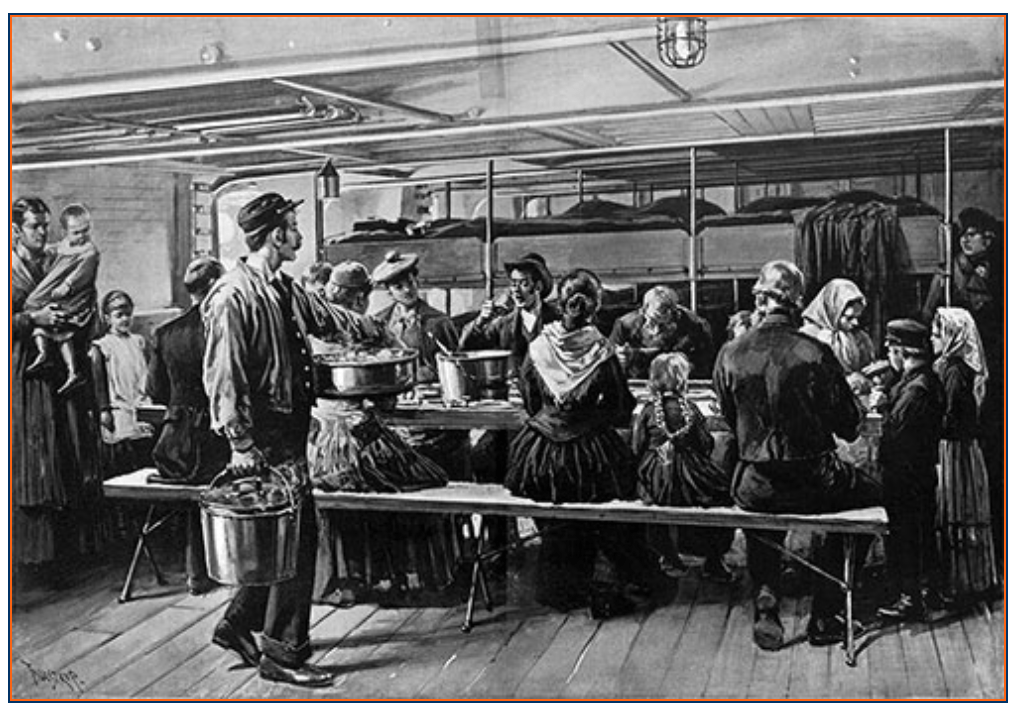
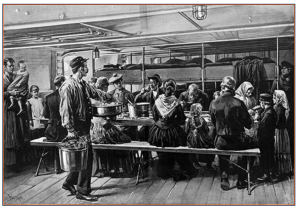
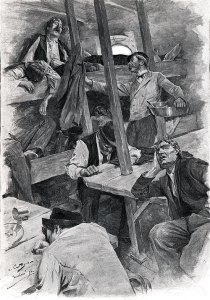
Life in steerage was communal living with very little privacy in the late 1800s. Travelers were provided a sleeping berth, three meals (of questionable nutritional value) a day and they had the use of public restrooms. But in most cases water for washing was saltwater. Drinking water was rationed. Newer ships had electric lighting. The S/S California, on which Fazio Paolini traveled, did not. Harper’s Weekly Supplement, 22 November 1890
By now, the engines1 of the S/S California would have been rumbling, as workers with titles such as coal trimmers, firemen, stokers, and water tenders endured the back-breaking labor required to power the vessel, all performed in a soot-choked environment.
In the ship’s manifest, Fazio and Domenico are listed as being housed in “No. 1 MDSF.” There is also a “No. 2 MDSA.” I could find no definition for the acronyms. My best guess is mid-ship fore and mid-ship aft.
Although the S/S California could accommodate 150 first (or saloon) class, 80 second, and 700 third class,2 the ship’s manifest for this trip lists only 730 passengers without distinguishing their type of service. My guess, since virtually all the surnames listed are of Italian descent, is that the vast majority of these were steerage class.3
The S/S California ship manifest for May 20, 1897, including Fazio Paolini (No. 7) and Domenico Paolini (No. 9).
Once settled into their new home for the next few weeks, the passengers would no doubt have been excited and perhaps marveled at the thrill of traveling on a steamship. The boat likely made a stop at Palermo, Sicily, and possibly Gilbraltar, Spain. Relying on the ship’s manifest, I see only Italian surnames but none of Iberian origin.4
From there it was through the Strait of Gibraltar and out into the wide and often turbulent Atlantic Ocean.
It appears, based on weather reports from various newspapers on both sides of “The Pond,” that the weather was fortuitously uneventful in May 1897. There might have been some high winds when the S/S California departed Naples. Otherwise, it appears the barometric pressure was high5 for the Atlantic crossing, according to TheTimes of London, The New York Times, and The Boston Globe, indicating no storms. There were reports of an “anti-cyclone in Ireland” (a fancy term for a high-pressure system) and a volcanic eruption in Iceland. Temperatures were unseasonably chilly, with frost in parts of France and England. But that was about it.
A cutaway of the S/S Frisia, displays the fore and aft steerage compartments. The ship was launched the same year (1872) as the S/S California on which Fazio Paolini traveled. Both are very similar in design, as hybrid sailing/steam-powered vessels. And both had iron hulls. By the 1890s, steel was the prevalent material.
Still, for those unaccustomed to traveling by sea, the ride must have been quite bumpy and nauseating. Waves of 2 meters (6 feet) would not be uncommon in the open ocean, and swells much higher would certainly have been encountered. This would have given a boat the size of the S/S California quite a bouncing about.
By 1897, the Golden Age of steamship travel was well underway. But, as routine as traversing the seas was by this time, the voyage was not without its perils. There were icebergs, of course, which could be seen as far south as Bermuda. The fog was always a challenge. And, although the Atlantic is a big place (41 million square miles), it was becoming quite crowded with vessels.6 This was the era before radar and other modern collision-avoidance systems. Even wireless telegraph was not yet available.
As dangerous as the open sea might be, it was the shores and harbors that were of most concern. Sand barges, rocks, shoals, or other ships in relatively close proximity all created challenges. The Utopia, for instance, collided with another ship in 1891 near the port of Gibraltar, costing 591 Italians their lives.
And when the steamers weren’t colliding with one another or other natural obstacles, there were boiler explosions, fires, and leaks to contend with. There were, by my count, 228 maritime accidents in the year 1897 alone.
Unimaginable living conditions
Those were not the only dangers lurking about. Inside the ship, in the congested, the infested, the dark, and nearly airless world of steerage, other hazards lurked.
Although, as previously noted, there were vaccines available and likely administered for cholera, typhoid, tetanus, and bubonic plague, there were many other contagions all too prevalent and easily transmissible in this type of environment. They included: tuberculosis, diphtheria, influenza, pertussis, yellow fever, polio, measles, and mumps, to name a few.
Death was a common enough event that the ship’s manifest included a column to register any passengers who might have died on board.
Children and babies were especially vulnerable. The passenger-ship mortality rate for children between the ages of 1 and 12 was 7.5%, and for infants, 19%. This was after the enactment of several U.S. laws, starting in 1872. Before this, the overall mortality rate for all passengers was even higher.
Ship doctors were, by most accounts, unqualified and unable to address the infirmed with any measure of success.
‘This has been a sad day, we have had 5 deaths, all children, the people seem to think it is a doomed Ship & have lost all heart …”
Conditions in steerage remained vile at best well into the 20th Century. Inadequate ventilation, substandard (and often unusable) bathrooms, lack of lighting, virtually no privacy, and inedible food are among the myriad violations cited during ship inspections. Rats, cockroaches, ticks, and lice ran rampant. Many passengers were seasick for most of the trip. The odors of rotting food, body odors, and engine fumes made it nearly impossible to breathe. And by most accounts, the companies running these vessels looked the other way.
In 1912, the British steamer Orteric was fined $7,960 for its abusive treatment of steerage passengers. The report detailed the following:
Among her 1,242 passengers, there were in the eight weeks of her voyage 58 deaths, 57 being children; the births numbered 14; the sexes were not properly segregated during the larger part of the time, the ventilation of the ship was inadequate and greatly increased the mortality rate; the hospital facilities were ill-ventilated and without proper equipment; while the sanitary conditions of the vessel were almost beyond belief.
On top of all this, women and girls faced not only routine harassment but sexual assaults. A report to the U.S. Senate in 1909 notes just how appalling conditions were, leaving little to the imagination.
And in those incredibly inhumane conditions, there was the overwhelming boredom. Passengers might try to pass the time by playing cards, talking about their plans in the new land, or even singing and dancing. There were at least 2 musicians on board the S/S California for this voyage; perhaps they helped provide some entertainment.
And so, after two or three (or more) weeks of these unbearable conditions, it is not hard to imagine the overwhelming feeling of relief that must have been felt upon first sighting land again.
And you can imagine the thrill when they spotted the Statue of Liberty welcoming them to their new home.
1 The ship, built in 1872, had its engines overhauled in 1881.
2 The ship was later modified to accommodate up to 1,200 steerage class passengers, but as noted, the total number of passengers on this trip was 730 in all classes.
3 [North Atlantic Seaway by N.R.P.Bonsor, vol.1, p.457]
4 My father, Claude Albert Paolini, claimed that Italian surnames ending in “i” were from Northern Italy, and those with “o” from the south, especially Sicily. I have only recently uncovered corroboration of his theory.
5 Barometric pressure readings in Rome (just north of Napoli), London, Paris, and New York during this timeframe were between 29.9 and 30.1. These are normal “high pressure” readings and indicate little chance for a storm.
6 Among the ship companies transporting emigrants were:
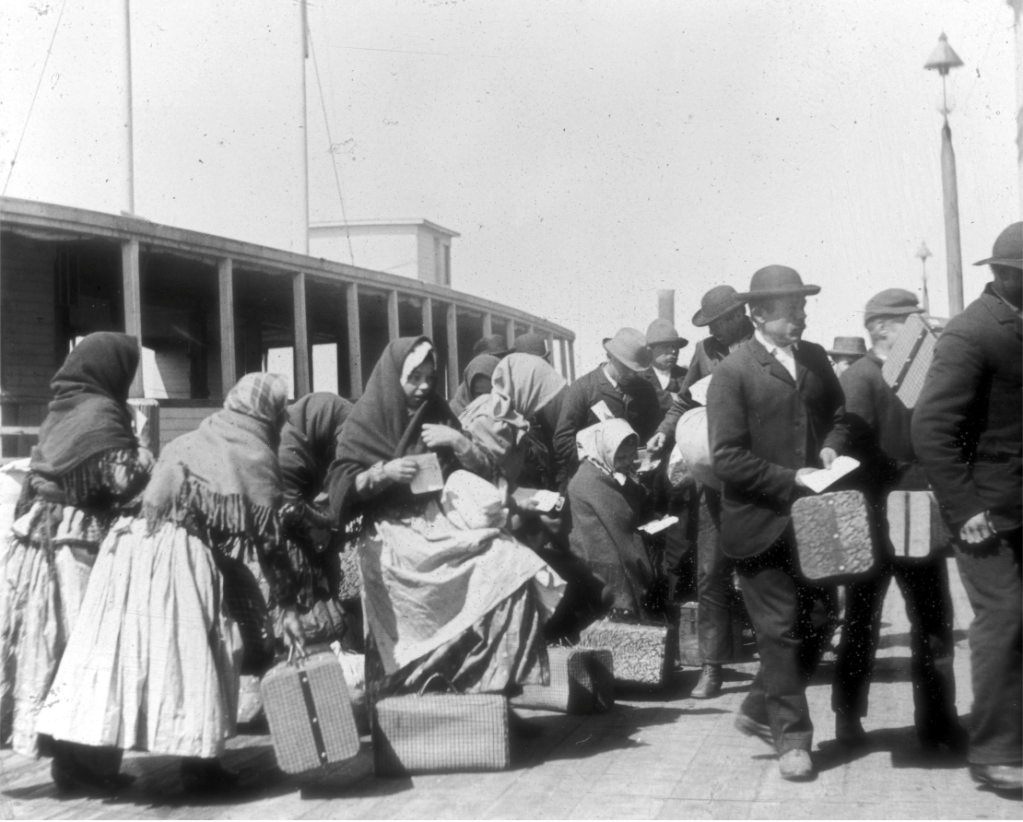
Immigrants arrive at Ellis Island, at the turn of the 20th Century.
AFTER THE SS California steamed past the Statue of Liberty, the aging vessel berthed at Ellis Island. As Fazio Paolini and the passengers disembarked, they joined the daily throng of 5,000 or so fellow emigrants who had made the same arduous oceanic voyage and were now on their way through the same hallowed facilities. For first- and second-class passengers, there was little wait time. But even for steerage passengers, the process was efficient. If all went well, 98% of the applicants would be successfully admitted to their new homeland within hours. Contrary to common folklore, there were scant “lost in translation” moments, in which immigration officials arbitrarily spelled the new arrivals’ names in some Anglicized variation (changing “Paolini” to “Pauline,” for instance). Interpreters were available for all major European languages.
The next stop was an exchange station to convert currency. The passengers then purchased tickets for the ferry ride to the mainland, with a box lunch provided (courtesy of their new country) to enjoy on one last boat ride.1
An Italian passport, turn of the 20th Century.
A view of Ellis Island. The structure that Fazio would have seen upon his arrival was made of wood and burned downed a mere 3 weeks after he had passed through the facility. The iconic stone structure seen here was completed in 1900. It closed down operations in 1954 and opened as a tourist destination in 1976.
Imagine the sights and sounds of New York City in 1897. The five boroughs (still separate municipalities at the time) were already congested to the tune of 3.3 million people and 200,000 horses. By all appearances of film footage from the era, the “New York minute” was already a thing. The city was rapidly rising in its status as a world financial center, trading capital, shipping hub, and entertainment center.
A traffic officer guides pedestrians across the busy intersection of Broadway and Union in New York City, Sept. 25, 1896
For the middle and upper class, this was the Gilded Age, a sardonic term coined appropriately by Mark Twain, which referred to the era of excessive wealth. The New York affluent resided in Victorian mansions made of marble and granite, and the burgeoning middle classes occupied the iconic brownstones. There was electricity and steam heat, and trolley cars for transportation. Bicycles were all the rage, ranging in price from $10 to $100.2
Life was comfortable — and even entertaining — for the higher members of society.
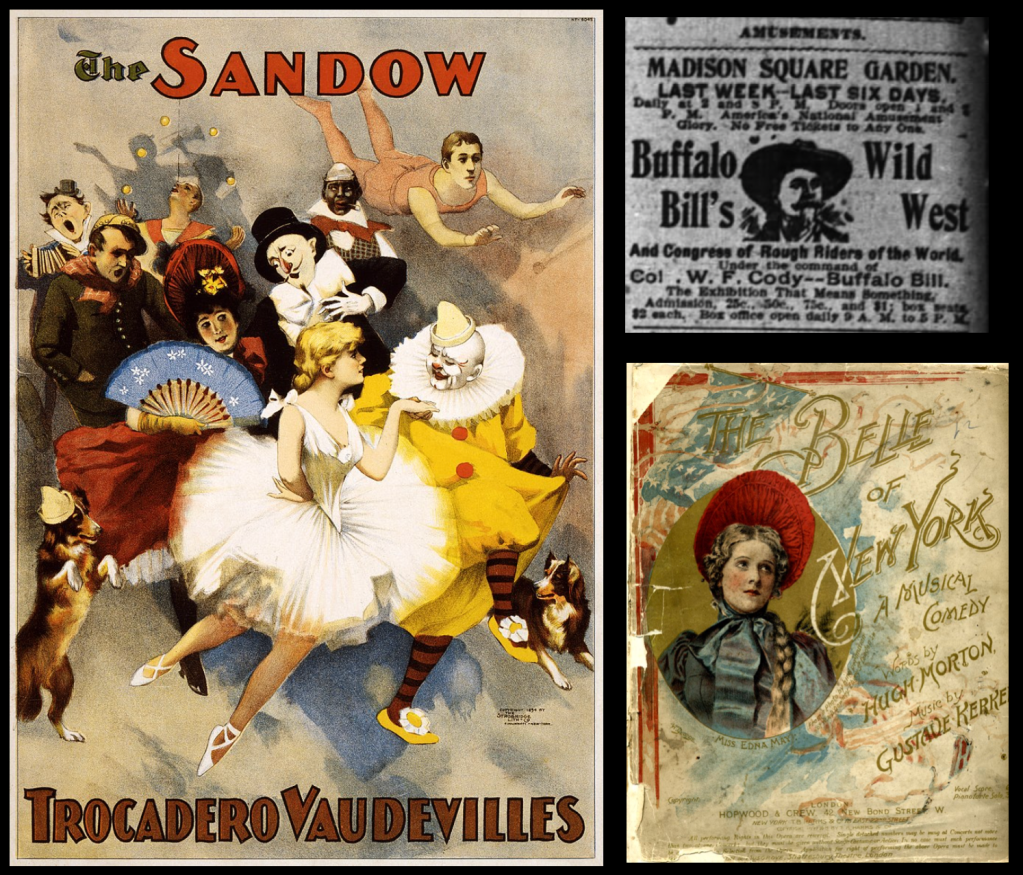
One could catch a performance of The Belle of New York on — where else? — Broadway, or perhaps hear Italian baritone Mario Antonio at the Metropolitan Opera House. For those who appreciated more prosaic forms of entertainment, there was Vaudeville, where acts included juggling, trapeze artistry, comedy, bawdy humor, and popular song. One of the more renowned shows in town at Madison Square Garden was none other than William F. Cody and his Congress of Rough Riders of the World. Tickets for this spectacle started at 25 cents.
Little wonder, with all the frivolity the city could offer, the last decade of the 19th Century would earn another nickname: The Gay Nineties.
At the turn of the 20th Century, New York City was well on its way to becoming a major scene for arts and entertainment.
BUT FOR THE MAJORITY of people in this megalopolis — some 2.3 million souls — the glamour of the upper class was just an elusive dream. Life for the underprivileged was as dismal as the boat ride that brought them to these strange environs. This disenfranchised mass of humanity was housed in one of countless, flimsy tenement houses that contained little to no running water, no bathrooms, and very little heat. And these wooden structures were prone to conflagration.
Not surprisingly, living in such close quarters also meant the rapid spread of communicative diseases, such as yellow fever, cholera, diphtheria, tuberculosis, and others.
The factories in which the lower class labored for 10 to 12 hours a day, six days a week, were either stifling hot or bone-chilling cold and noisy. Ventilation was inadequate, compounded by dust and other airborne particles. The workers toiled at machines, performing mind-numbing tasks. Factory workers might even be locked in during their work shifts, potentially condemning them to death in the event of a fire, as was the notorious case of the Triangle Shirtwaist Factory fire.
For immigrants such as Fazio, the discrepancy between the haves and have-nots would have been of little importance. He was ready to start a new life and to do what was necessary to succeed. In his first full day in the new land, Signore Paolini and the other 4,999 or so newcomers just off Ellis Island that day would have squandered no time seeing a show or the sites. They needed first to find shelter and food, and then to earn a living.
Newly-arrived immigrants crowd into a single room for a night’s sleep in 1898. Rent might have been as little as 7 cents.
Securing a place to sleep on the first night would have been the highest priority, yet it would not have been difficult. For 7 cents, one could find a sleeping bunk in a crowded room with a dozen or so other individuals. This would have been an improvement to the hull of the ship, but probably not by much.
Attaining gainful employment would have been the more difficult task. There were plenty of jobs to be had, but not for everybody. Discrimination was not only rampant, it was unapologetically blatant.
It is most likely that Fazio took whatever job he could find to get established.
Discrimination was rampant in 1897.
If he did not work in the myriad sweatshops at first, there were other options for Italians, almost all of them very dangerous. Among them were digging tunnels, laying railroads, and construction, most notably skyscrapers and bridges, such as the Brooklyn Bridge.
“I came to America believing the streets were paved with gold. The streets were not gold. They weren’t even paved. And then I learned that it was my job to pave them.”
Italian immigrant saying
There were three other occupations, however, that were available to Italian immigrants, and for the rest of his life, Fazio would be identified by one or all of them. These included:
–Brickyard worker
–Fruit vendor
–Farmer
It is quite likely that he began by laboring in the brickyards.
The evidence to support this postulation is largely based on two factors:
In order to become a fruit dealer or farmer, an immigrant would have had to have possessed considerable capital to finance the new enterprise. There is no evidence to support the theory that Fazio was a man of such financial means.
The location Fazio chose to settle was in the middle of New York State, along the Hudson River. This makes it very, very likely that he was working in the brickyards there.
Approximately 70 miles north of New York City, on the Hudson River, towns such as Newburgh, Beacon, Haverstraw, and New Windsor were humming with activity. The riverbanks of the renowned waterway on which these towns were situated were being mined for the massive amounts of clay and sand that lined the shores. These materials were then manufactured on-site into the ubiquitous rectangular building blocks used to erect the skyscrapers and other structures of New York City.
The brickyard jobs paid relatively well and even included housing. Italian, Irish, Romanian, and Hungarian immigrants were recruited right off the boat. At the time Fazio landed in the U.S., there were some 135 such manufacturing sites in Ulster and Orange counties, cranking out hundreds of millions of bricks each year. Virtually all the bricks used in The Big Apple from that time period until the early 1930s were supplied from the Hudson River manufacturers.
Brick manufacturing in New York State along the Hudson River Valley, circa 1900. It is likely that Fazio Paolini started his career in one of these factories when he arrived in 1897.
A remnant of a bygone era. Millions of old abandoned bricks still line the shores and banks of the Hudson River Valley, vestiges of the era between 1880 and 1930, the Golden Age of brick manufacturing in the area. Fazio Paolini was employed by Brockway Brick Company for 25 years. Photo courtesy of Robert Yasinsac.
As welcoming as the jobs in the brickyards might have been, they were not without peril.
Some clay mines descended 200 or more feet into the Hudson River bank. Sand and clay are not the most stable soils. Mine collapses were a very serious risk. The most notorious incident was in the town of Haverstraw in 1906, when mine shafts were bored directly under the town. A good portion of the enclave’s commercial buildings and homes collapsed into the void, causing a landslide and fires. Miners and residents alike died in that tragedy.
Whatever Fazio did to earn a living in 1897, this much is known: he earned enough in the first year to finance travel for his wife, Francesca, daughter Consetta, and brother Sabatino. Almost a year to the day from Fazio’s arrival in America, the three family members departed Naples, Italy on the SS Fulda, arriving on May 5, 1898, just in time for Fazio’s 30th birthday.
No doubt, that voyage was a difficult one, especially for Francesca and little Consetta. As noted in the previous chapter, traveling in steerage was dangerous at best for a woman. But, at least, Francesca had brother-in-law Sabatino to protect her against unwanted advances. And tiny Consetta clearly beat the odds of infant mortality aboard steamers, much to her mother’s gratefulness.3
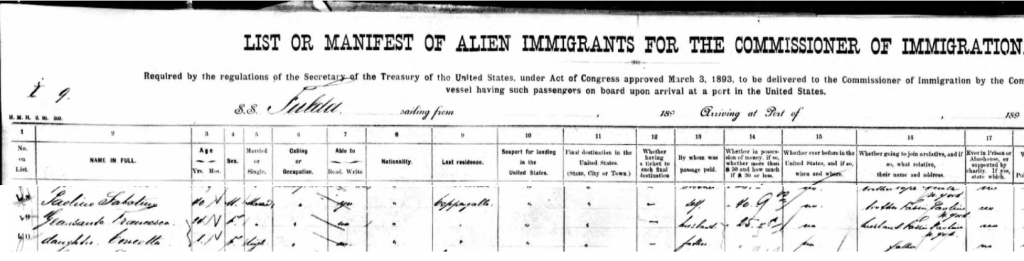
Sabatino Paolini (listed here as Paolino) and Francesca Paolini (listed here as Giansante) arrive with baby Consetta on May 8, 1898, just shy of a year after Fazio Paolini came to America. Fazio is listed as the relative they are going to meet.
In 1899, daughter Mary Victoria Paolini was born, and the birthplace is listed as Wappinger Falls. Located on the east side of the Hudson, this town was bustling with factories (20 of them). Wappinger Falls is adjacent to the town of Fishkill, where Brockway Brick Co. had mining and manufacturing operations. Whether Fazio was employed by Brockway at this time, we do not know for sure. But it does seem to be more than a coincidence.
But by 1900, the family was firmly established in Newburgh, New York. The census in that inaugural year of the new century lists Fazio and family at 225 Pine Street, Newburgh.9 And it is here that we see the Fazio listing his occupation as “fruit dealer.” My guess is that Fazio’s entrepreneurial endeavor was a side hustle more than his principal gig since he was an avid (and from accounts, successful) gardener. Sharing the “fruits” of his labor via a vending cart was a profitable hobby that he pursued his entire life.
The 1900 Census lists Fazio, Francesca, Consetta, and the newest family member, Mary. Note that Fazio and Francesca had not yet been naturalized as U.S. citizens and are listed as being unable to speak, read or write in English, according to the census form.
The Verplanck years
AS WAS VERY TYPICAL of new immigrants, Fazio and his family moved quite a bit. There is no record of homeownership during their lifetimes. But without a doubt, the one place they called home that generated the fondest memories was a large, rather run-down mansion on Plum Point, overlooking the Hudson River in New Windsor, New York.
The structure was built by and once inhabited by one of the very first European families to settle in America: the Verplancks, a family of Dutch lineage that can trace its American ancestry to 1633, when New York was still known as New Amsterdam. (This was a mere 24 years after Henry Hudson sailed up the river that now bears his name.)
By 1915, Fazio and Francesca had changed their names to Frank and Frances. Nearly all their children would also be given Anglicized given names.
By 1920, the younger boys — Joseph, Anthony, and Claude had joined the family.
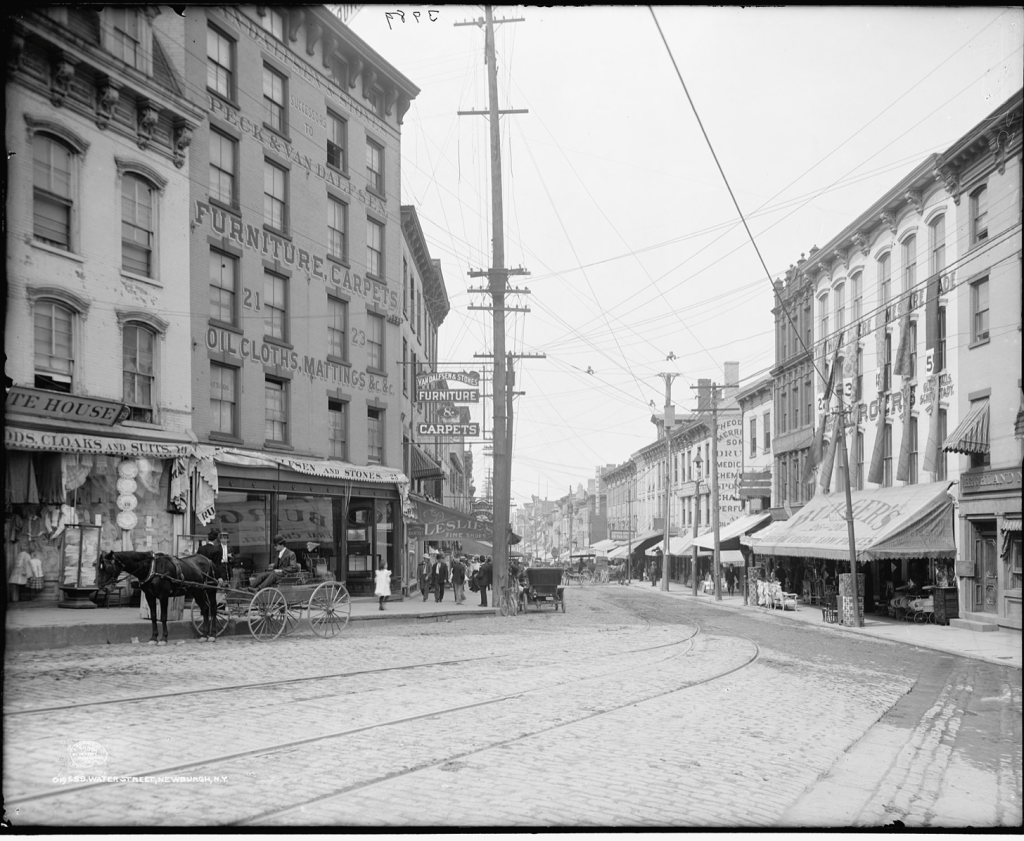
Water Street in Newburgh, circa 1906. Sadly, these buildings were demolished as part of a federal “urban renewal” project in the 1960s. (Public domain photo)
The Verplanck home was at this time owned by the Brockway Brick Company, which provided the domicile — as well as a few acres of land on which the house was situated — rent-free to Fazio, who was by this time a foreman of that company.
The exact dates during which Fazio Paolini and his family lived in this mansion are not clear. But a little guesswork, based on available records, suggests it was between 1911 and 1929. It was in this home that most of the children of Fazio and Francesca were born. My father, Claude, the youngest of the children, regaled his prodigy with stories of life on the farm. And I’m sure Claude’s siblings relayed similar stories to their children. Among the tales are these little anecdotes:
The home had a unique design, with two identical entries. Each of these doorways was framed by a two-story-high portico, supported by six massive Doric columns. The younger boys — Joseph, Anthony, and Claude — would ride their bikes from one porch to the other, directly through the house, no doubt to the chagrin of their mother.
Uncle Ray, the second oldest of the boys, was ever the prankster and troublemaker, teasing sister Madeline (Molly) to her wit’s end. One such escapade involved tying a string to the “water closet” and tripping the flushing mechanism from another room while Molly was seated.
It was in this home that Raymond fell down the main stairway. His mother was in tears, believing him to have died in the descent. But he lived many years beyond that accident to tell the tale.
Fazio had a massive garden that included prize-winning watermelons and grapes for fermenting his own wine.
At some point, Fazio held the ceremonial title of deputy sheriff for Orange County. He took his role seriously, however, since on more than one occasion petty thieves or drunkards were held in the chicken coop until they could be remanded to official custody.4
Fazio was also active in local society. According to newspaper articles, he helped to organize an annual town picnic at Plum Point. And, apparently, he remained active with his fruit cart, selling not only fresh produce but cigars, cigarettes, and ice cream at these town gatherings.
A plow horse once suffered an intestinal obstruction. A veterinarian had the unenviable task of removing the blockage using nothing more than his hand and some lubricant. For the younger boys in the family, observing this “operation” was more entertaining than sneaking in the side door of the movie theater.
The Verplanck Mansion on Plum Point in New Windsor, New York, was the residence of Fazio Paolini and his family for many years.
Every farm must have a dog, of course. And the story of the family canine named Pat could have been the inspiration for the Disney tearjerker “Old Yeller.” Pat, apparently, became rabid, and eldest son Paul received the sad task of putting down the infected animal with his father’s gun. Before pulling the trigger, however, Paul bid his farewell to the beloved canine, with the now memorialized phrase: “Goodbye, Pat.” 5
Fazio’s brother, Sabatino, was apparently quite the carpenter. He built, among other things, a beautiful dining table, crafted from cherry wood. He also made his own wooden vice, carving the screw by hand.
There must have been some boisterous family dinners. One involved Fazio getting so angry that he pounded the corner of that cherry table with such force that the edge broke off.
From left to right, Anthony, Claude, and Joseph as boys at the time the family resided in the mansion on Plum Point. Could this be Pat the dog in the foreground?
It must have been one busy household. Sabatino (who changed his name to Samuel), was married and had children. If he and his family were not living with Fazio and his family at this time, he apparently was spending a considerable amount of time there.
And Consetta, who changed her name to Catherine (and was known to us as Aunt Kate), was married to Ercole Totonelly, and they had two children by 1915 as well. Records indicate they also lived in this home for some time.
Life during the Verplanck years had its share of grief, as well. Sabatino’s son, Anthony, died in his first year of life in 1914.
Albert Paolini, the twin of my father, Claude, died either in childbirth or as a result of the pandemic sweeping the country in 1918.
Daughter Mary died giving birth to her second child, John, in 1920.
There is no clear record of when the family moved out of the Verplanck residence. But it is highly likely that the Great Depression, which began to sweep across the country in late 1929, was the cause. By 1930, the homestead had been relocated to 245 Grand St. Apparently, Fazio maintained his job as foreman for the Brockway Brick Co. Records also show that daughter Lena was now married to Sebastian Scrivani and that they were living at that address as well.
The Fatal Fall
WHAT BEGAN AS A PROMISING spring day turned into a disaster of unimaginable proportions. And the Paolini family would never be the same from that moment on.
Sunday, March 9, 1930 was unseasonably warm and clear. Fazio, Francesca, and the family walked the 12 or so blocks from their home at 245 Grand St. to attend Mass at the Church of the Sacred Heart, in Newburgh.
It was the first Sunday of the Lent season. What sermon the Rev. Cyrus Falco6 delivered in the relatively new church that day, we do not know. But it is likely that Fazio, a devout Catholic, and an active church member, had not paid much attention to the pastor’s words on that morning. He had other things on his mind, especially regarding what was to transpire after the service.
The church, erected in 1912 to serve the needs of Italian Catholics in Newburgh, was not only close to home but was also located just one block from the Ford Motor Company’s dealership on Mill St. And immediately following Mass, Fazio and Francesca began to make the short walk to the auto showroom, while the children and grandchildren returned home. This was the day that Fazio and Francesca would purchase their first new automobile.7
This was a rather tenuous time to make such a large purchase. A new car, such as the Model A, was selling for somewhere between $500 and $800 (approximately $8,000 to $10,000 in today’s currency). That was a sizeable amount of cash to spend, especially since the stock market crash of the previous October ignited a panic that included runs on banks, in which panicked citizens were demanding to withdraw their savings. Banks could not keep up with the demand, and the institutions started failing.
But none of this would you know reading the front pages of the newspapers at the time. There was news, to be sure: William Howard Taft, the former president, and, at the time, Supreme Court Justice,8 had died that very day. Babe Ruth had just signed a record-breaking deal to renew his contract with the New York Yankees, and world-renowned aviator Charles Lindbergh had been thrown from a horse but survived intact, save the embarrassment.
And, if the advertisements in the newspapers were any indication, the economy was as robust as ever, with a high demand for new gadgets, such as an Atwater Kent Electro Dynamic Radio for $109 (or just $2 per week for one year after making a $5 down payment).
Advertisement for a 1930 Ford Model A.
But there were hints of unrest. Unemployment was already on the rise to the extent that citizens took to the streets to protest. In New York City’s Union Square, apparently, 6,000 people showed up and were promptly labeled as Communists. Hence, the news was more about a “Red Scare” than the average citizen’s reaction to the historic economic collapse that was unfolding.
Yet, Fazio must have felt confident enough in his management role at Brockway Brick Company to not only contemplate but follow through with such a large purchase. Perhaps the acquisition of the automobile was to ensure he could continue to work on-site at the company since he would have had to commute the 5 or so miles from the family’s new residence to the Brockway factory. Whatever the incentive was for purchasing the new automobile that day, it all became moot within minutes of leaving the church.
What really happened
For years, we knew the story. Grandpa Frank (Fazio) had died from a fall down a flight of stairs. As kids, we just assumed this fatal descent occurred on the farm and that his death came quickly. Whether our father knew the actual story or not, I’m not sure. He would have just turned 12 at the time. But his older siblings — Paul, Lena, Raymond, Molly at least — certainly knew.
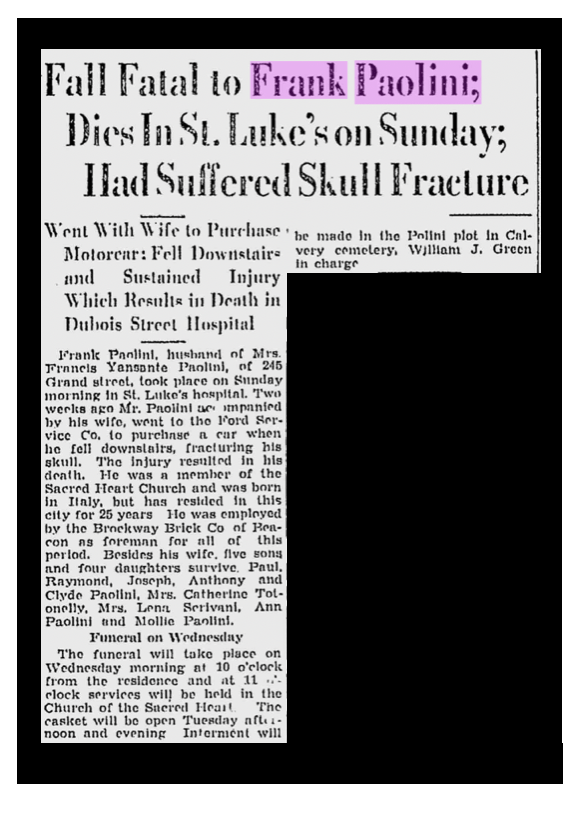
News of Fazio Paolini’s death made headlines in March 1930.
Exactly what happened on that fateful day is not entirely clear. But thanks to newspaper articles and legal documents, we know this much: Fazio and Francesca Paolini left the services at the Church of the Sacred Heart, walked around the corner, and entered the Ford dealership at 60-64 Mill St. with the intent of buying that new car. Once in the showroom, Fazio apparently went into the garage, presumably where the vehicles were serviced; quite likely he was planning to inspect the operation. But, unfortunately, he entered a doorway in the garage that, unbeknownst to him, led to a stairwell. Perhaps there was inadequate lighting. But somehow, Fazio fell down the flight of stairs, fracturing his skull.
From that moment, Fazio was unconscious and rushed to St. Luke’s hospital. He remained in the medical facility for two weeks, at which point he finally succumbed to his injuries. His funeral was held at the very same church that he had left that fateful Sunday morning, and the body was interred in Calvary Cemetery.
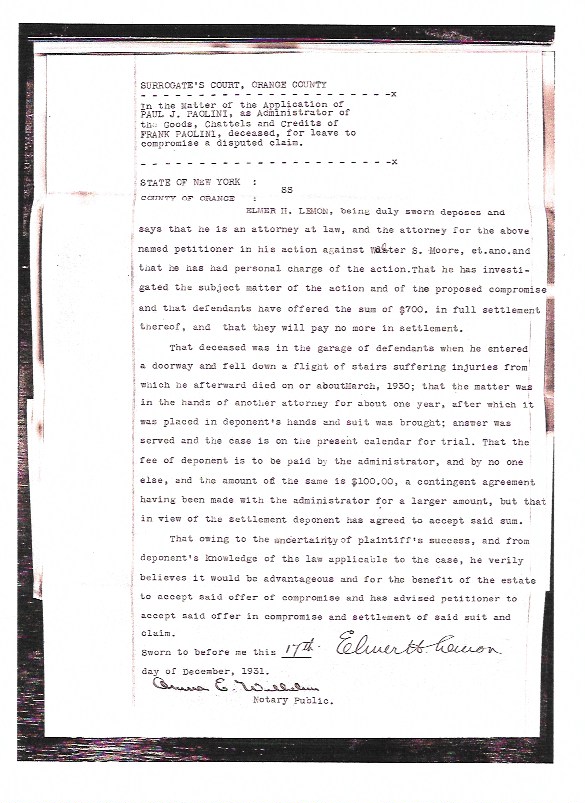
After getting over the shock of the accident, the family regrouped and decided to press charges against the Ford Motor Company. Paul, as the eldest male in the family, assumed command of the situation, spearheading the lawsuit. After 18 months, the litigation was settled out of court, and either the Ford dealership, the Ford Motor Company, or both, agreed to pay $700 without admitting guilt.
Settlement of the lawsuit against Ford and its dealership.
But even that pittance of remuneration must have been welcomed. By the time the suit was settled, the Great Depression was in full force. Every member of the family had to find a way to contribute. Even young Claude, who by this time was almost 14, dropped out of school to work.
Francesca Giansante Paolini in her later years.
The family persevered through that awful incident and the depression. Francesca would survive her husband for another 29 years. I only remember meeting her once, when she was very ill. She died on my fourth birthday: June 22, 1959. Her memorial service was held at the very same church as Fazio’s, and she rests next to him in the Paolini plot in Calvary Cemetery.
This is about all we know about Fazio and Francesca’s history and life. But, there are many things we can infer. To begin with, all of their children were decent, caring individuals, parents, aunts, and uncles, who made their contributions to family and society through honest and earnest work.10
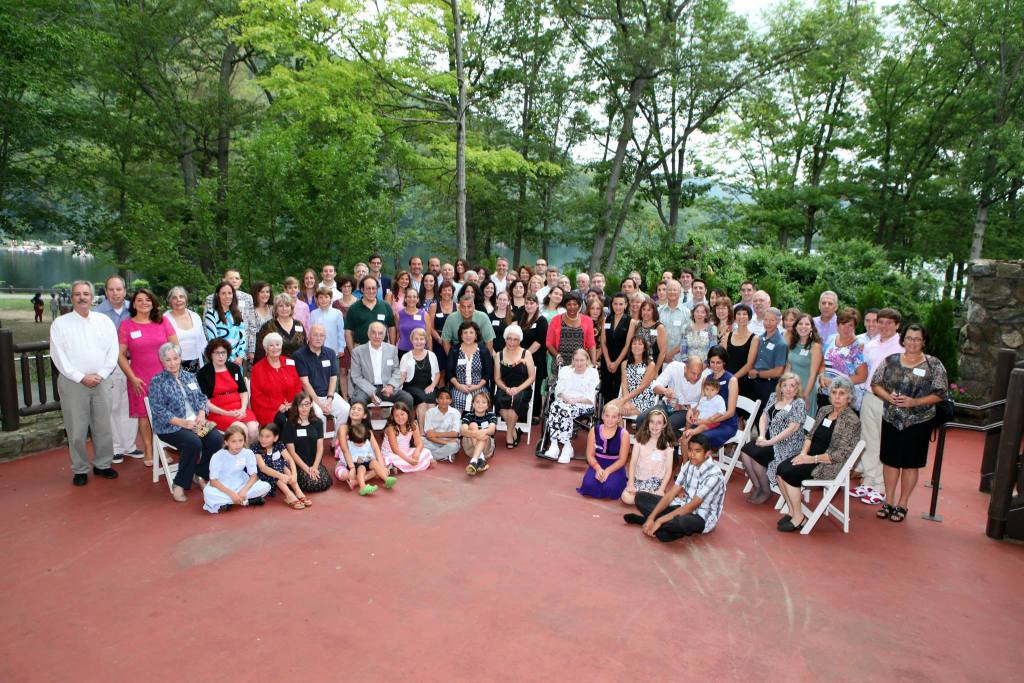
The reunion of the progeny of Fazio and Francesca Paolini in 2014 at the location of the family’s most renowned home at Plum Point, on the Hudson River, New York.
The last reunion of their progeny — grandchildren and great-grandchildren — occurred in August 2014, at the very site of the Verplanck Mansion, which had been torn down many years prior. Well over 100 relatives from all corners of the United States attended.
Over the course of that weekend, we celebrated our common heritage and the uniqueness of our story. It is, of course, just one story, among the 12 million or so that passed through Ellis Island between 1892 and 1954.
Acknowledgements
For as long as I can remember, I have had a fascination with my family’s history. Fortunately, that enthusiasm has been shared by my siblings and many cousins. My goal in this narrative has been to put together the story for current and future generations.
Fazio and Francesca’s names are memorialized in the Great Wall at Ellis Island, honoring the millions of immigrants who began their new lives on that spot.
I’d like to thank a number of people for their guidance, assistance, and support.
My late cousin Linda Paolini Gauthier was a big inspiration. She had visited the relatives in Cepagatti, Italy, and continued to research the family history beyond that trip. It was Linda and her sister, Joanne Paolini Diaz, that organized the reunion in 2014 and put together the framework for our family history that got me thinking about crafting this into a story. Cousin Carl Aiello also helped in this regard.
I was very fortunate to find a number of individuals who, despite having no incentive to help me, did just that. These include Glenn Marshall, the town historian in New Windsor, New York, and Pierangela Badia, who holds a similar title in Cepegatti, Italy.
Hand-drawn family tree, created by Claude Albert Paolini circa 1980.
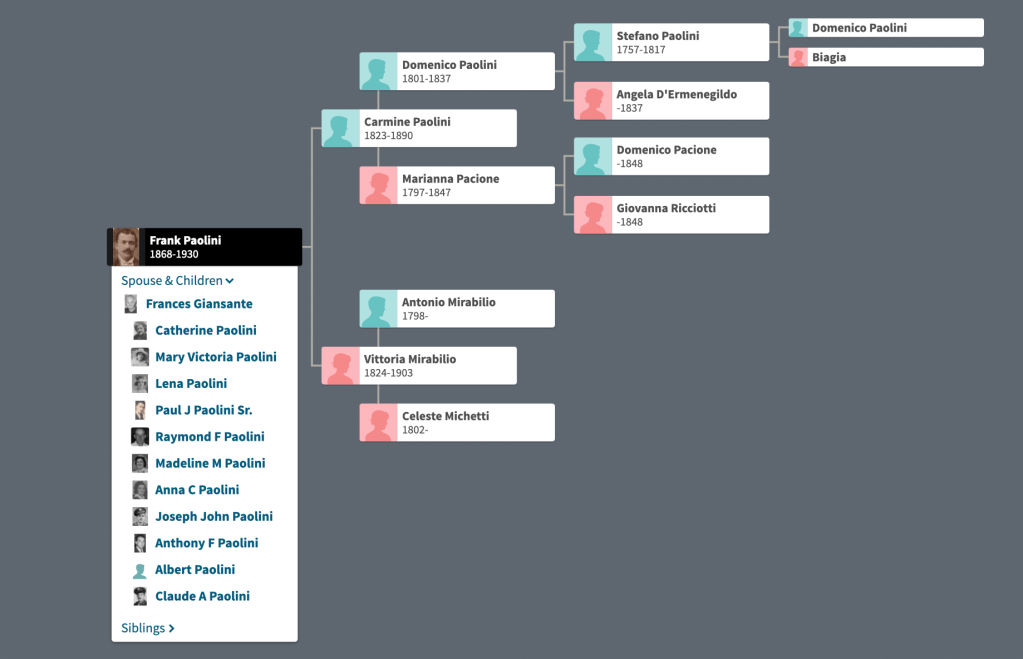
Family tree of Fazio and Francesca’s ancestry and of their children.
Footnotes
Contrary to popular belief, the process at Ellis Island was quite efficient. Passengers disembarked their ships with a passport and copy of information related to the ship registry and entered the Immigration building. There, they were interviewed (a list of 29 questions) to ensure they would qualify as upright citizens. The interview was conducted in their native tongue, to ensure accuracy. Interpreters of every major European language were available. The passengers were also required to undergo a physical exam to determine whether they were carrying any infectious diseases. Only 2% of all applicants were either detained for further questions or turned away altogether.
In today’s dollars, those new bicycles would have cost between $337 to $3,378.
As noted in the previous chapter, the passenger-ship mortality rate for children between the ages of 1 and 12 was 7.5%, and for infants, 19%.
For years, I held in my possession a small leather notebook with a pen and pencil set, given to me by my father. On the cover, the words: “Frank Paolini, Sheriff” were embossed. New Windsor Town Historian Glenn Marshall assures me that the title was ceremonial in nature since there is no record of any Paolini being elected as a law enforcer in this time period.
The story of Pat was told by Paul Paolini to his son Frank, who shared the anecdote in an essay memorializing his father.
Reverand Falco is listed as the pastor of record at Newburgh’s Church of the Sacred Heart in 1930.
I found it unusual that the Ford dealership would be open on a Sunday. (Even in the 1960s, when I was a child, very few stores were open on a Sunday.) But legal documents regarding the incident confirm this to be the date. Perhaps this was a grand opening for the dealership or some other special event.
Taft is the only individual to hold the offices of the U.S. President and Chief Justice of the Supreme Court.
The structure at 225 Pine Street in which Fazio and family first lived must have been demolished. A new home was built there in 1949, according to city records.
There were tales of Uncle Ray Paolini smuggling booze from Canada during Prohibition. Legend has it that Ray drove a Packard wagon with a roof that had been modified into a flat tank to store and transport the contraband.
Fun facts
The five boroughs of New York — Manhattan, The Bronx, Brooklyn, Staten Island, and Queens were still separate cities in 1897. On Jan. 1, 1898, they incorporated as New York City. New York’s five boroughs were the home to myriad types of manufacturing at the turn of the 19th Century, including the making of drugs, chemicals, paint, furniture, and housewares such as china and glass. The processing of paper, raw cotton, and tobacco for shipping to other countries were also big industries.
At the time Fazio Paolini landed in New York, there were still 200,000 horses used for the transportation of people and goods. Each of these four-footed friends produced 24 pounds of manure and up to a half-gallon of urine per day. There was no adequate system for removing this animal waste.
Animal waste, garbage, and snow could pile up to six feet high in New York City. This is one of the reasons the famous Brownstones required a flight of stairs up to the first level, to rise above it all.
With the massive influx of 12 million new citizens, there was an abundant supply of labor, which kept wages excessively low. Regulations limiting worker hours and clamping down on the exploitation of child labor were still a few years away.




















 IRON-AGE EPILOG
You must be logged in to post a comment.